
Grease Trap Compliance
The manifests, logs and disposal records that prove your trap has been serviced properly, kept in a form an inspector accepts.

Any food service operation subject to health department or county FOG requirements, and any operator who has been asked for records and could not produce them.
How a job runs, step by step
Manifest every service
Each visit generates a manifest showing what was removed and where it went.
Document each visit with images
Photos are the fastest way to demonstrate that a cleaning was complete rather than a skim.
Keep the disposal chain
Disposal at an approved facility, documented, under our permits.
Maintain the log
A running service history with dates and intervals, so the file tells a coherent story instead of a pile of receipts.
What an inspection actually asks for
An inspector is generally not standing over the trap with a ruler. They are asking whether this operation has a maintenance program and whether it can prove it. Dates, intervals, what was removed, where it went, and whether the pattern is consistent. A kitchen with a clean file and a sensible interval is a short visit. A kitchen with no records is a long one, whatever condition the trap is in.
Records as an operating tool
The file is also useful to you. A service history shows whether your interval is right, whether loading is climbing, and whether a piece of hardware keeps showing up in the inspection notes. That is the information that turns a reactive schedule into a program, and it costs nothing extra to keep. A trap that used to hold ninety days and now needs sixty is telling you something about the kitchen upstream, whether that is a new menu, a new fryer, or somebody pouring oil down a drain at the end of a shift. The file is where that shows up before the blocked line does.
The 25 percent rule is what the record is proving
Every FOG ordinance in this part of the state comes down to the same requirement: service at a quarter of capacity or every ninety days, whichever comes first. The physics behind it is straightforward. A trap works by holding wastewater still long enough for grease to float and solids to sink, and once accumulation eats a quarter of the volume there is no longer enough quiet space for that to happen. Flow starts carrying FOG straight through the outlet and into the lateral. So the manifest is not a bureaucratic artifact. It is documentary proof that the trap never got far enough past that line to start putting grease into the collection system, and that is precisely the question the inspector is there to answer.
Why a manifest, specifically
A receipt says you paid somebody. A manifest says what material left your property, how much of it, who hauled it, and which approved facility received it. That chain is the whole point, because the alternative failure mode is a hauler who pumps a trap and then empties the tank into a storm structure or a convenient manhole a few miles away. That happens, it is the reason the manifest system exists, and when it is discovered the generator gets asked where their waste went. Our haulers permit, our dumping permit and USDOT 4547071 are the front end of that chain, and the manifest is the back end. Both belong in your file.
The file an inspector wants to see
Manifests in date order, before and after photos from inside the structure, disposal documentation, and a service log showing dates and intervals. Photos matter more than people expect, because they are the only thing in the file that distinguishes a complete pump-out from a skim. A trap photographed empty, walls and baffles scraped, hardware visible, is an argument nobody has to make in words. Add notes on anything found, a cracked wall, a missing baffle, a failed flow restrictor, and what was done about it. A file that shows problems found and fixed reads far better than one that shows nothing ever went wrong.
Worth knowing
Records are worth nothing if nobody at the location can find them. Decide where the file lives and who keeps it before you need it.
Ask any contractor where what they pump out actually goes. It is a fair question, and the answer tells you a lot.
VacRite
Other grease work
The other side of the company
Most of our customers only ever need one half of what we do. It is worth knowing the other half exists.
Something failed tonight. Somebody answers.
Struck line, blocked kitchen drain, a basin backing up in the middle of a storm. We run every day of the year, and the phone reaches a person rather than a queue. This company is first responder owned, and the emergency side of it works the way that suggests.
Questions we get asked
What documentation do we receive after each service?
A manifest, before and after photos, and disposal records showing where the waste went.
Why do inspectors want manifests?
A manifest closes the loop. It shows the waste was removed and legally disposed of, rather than removed and put somewhere convenient.
Can you reconstruct records from past services?
We can provide complete records for work we performed. We cannot document work done by somebody else, which is a good argument for keeping the program with one company.
Do you send reminders when a service is due?
Yes. Scheduled maintenance reminders are part of how the program is meant to work.
What if we have been cited already?
Tell us what the citation says. Getting the service and the records back on a defensible footing is a normal thing to be asked for.
How long should we keep the records?
Longer than you think you need to. Requirements vary by jurisdiction, and the practical answer is to keep a rolling multi-year file rather than trying to remember which year matters. It costs nothing to hold and it is the only version of the story that exists once the staff who were there have moved on.
Why do photos matter if we already have manifests?
A manifest proves the waste was hauled and legally disposed of. Photos prove the trap was actually emptied and scraped rather than skimmed. They answer different questions, and the photo is the one that separates a complete service from a vendor who took the floating layer and left the solids on the bottom.
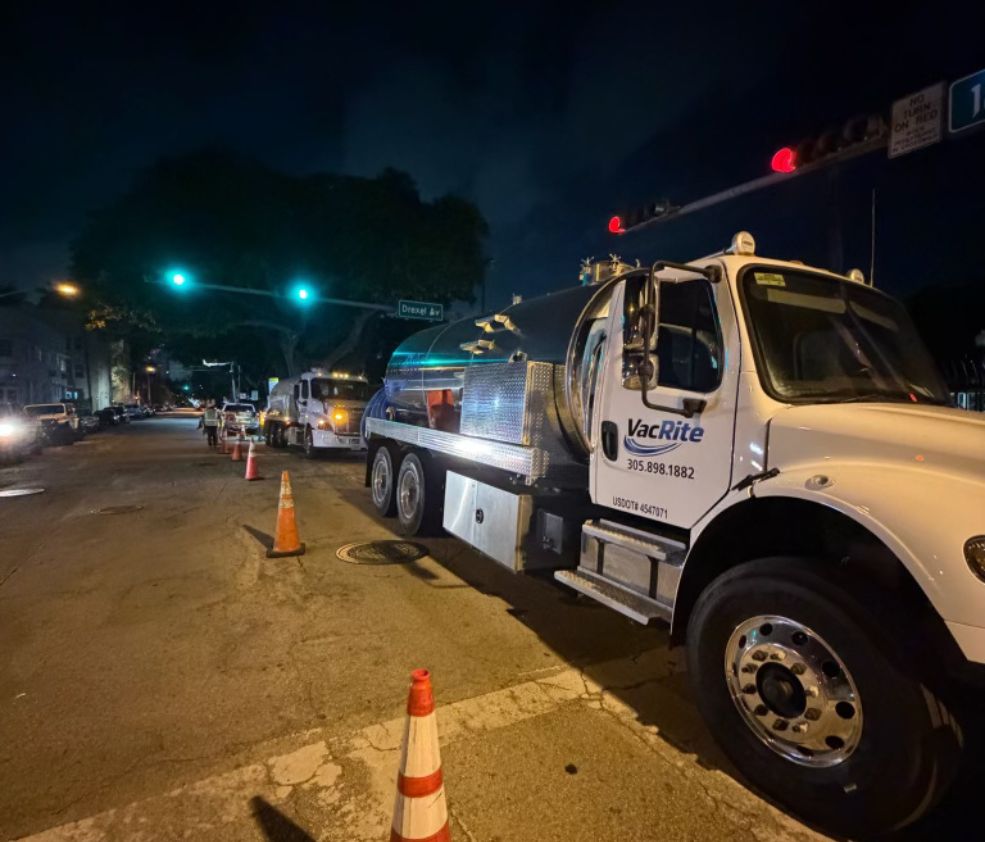
We run grease trap compliance across South Florida, including Miami, Fort Lauderdale, West Palm Beach, and the rest of the region. See every city we cover or look at the trucks on the job.
Tell us what the job is
Tell us about the grease trap compliance job. Where it is, what is around it, and when you need it.
Two trades, one call. We own the trucks, hold the permits, and put our own people on the job.
VacRite, Miami
info@vacriteservices.com
Open 24/7/365
USDOT 4547071