
Catch Basin Repair
Fixing the parts of a storm structure that have failed, the walls, the invert, the frame and the grate, while leaving the structure itself in the ground.

Property managers and municipalities who have been told a basin is in bad condition and would rather repair it than tear out and replace a structure that is otherwise sound.
How a job runs, step by step
Empty it and look at it properly
Nothing can be judged through standing water. The structure gets vacuumed out, washed down and inspected dry, because a wall that looks alarming with water in the sump is sometimes fine and a wall that looks fine is sometimes not.
Decide honestly between repair and replacement
Some structures are worth repairing and some are past it. You get told which one you have, with photographs, before anybody starts.
Repair the structure from the inside where possible
Spalled and cracked walls get cut back to sound material and rebuilt. Failed joints and active infiltration points get sealed. Most of this happens without opening the pavement at all.
Rebuild the invert so water moves again
The shaped channel at the bottom gets reformed to carry flow to the outlet instead of letting it stand. This is the repair that most often gets skipped and most often matters.
Reset the frame and replace the grate
A frame that has worked loose gets reset in the surrounding surface and the pavement around it repaired. Cracked, broken or missing grates get replaced with the right casting for the location.
What actually fails in a storm structure, and in what order
A catch basin is a concrete or block box sitting in wet ground with traffic running over the top of it, and it fails in a fairly predictable sequence. The invert goes first and quietly, wearing down or silting in until the bottom holds a permanent pool instead of moving water to the outlet. Then the walls, which spall from the inside where nobody is looking, especially at the pipe penetrations and the joints. Then infiltration, since around here the water table sits close to the surface and groundwater will find any failed joint and bring fine material in with it, which is what starts hollowing out the ground beside the structure. The frame is usually last and loudest. It works loose from the surrounding pavement, starts moving under traffic, and then breaks up the asphalt around itself in a circle that grows every month. Almost none of that is visible from the grate, and all of it is obvious in the ten minutes a structure is empty, washed and lit.
Repair or replace, and how to tell which one you are looking at
The honest line is not complicated. If the box is structurally sound and the failures are in the surfaces, the invert, the frame and the grate, repair is the right answer and it keeps the pavement mostly intact. If a wall has failed through, if the structure has settled out of grade, if the connecting pipes have separated at the penetration, or if there is a void behind the wall where soil has been washing in for a year, then a repair is decoration on a structure that is going to fail again. Replacement is work we do as well, which is worth saying because it means the recommendation is not shaped by what we happen to be able to perform. A vendor who only cleans will tell you the walls look bad and leave. A vendor who only replaces will find a reason to replace. You get photographs of the actual condition and a straight answer about which side of that line your structure is on.
Rebuilding walls and stopping infiltration
Wall repair starts with removing everything that is not sound, because patching over deteriorated concrete produces a repair that debonds and falls off in a season. Spalled material gets cut back to solid substrate, exposed and corroded reinforcement gets dealt with, and the section gets rebuilt. Where groundwater is actively coming through a joint or a crack, the water has to be stopped before anything cementitious will cure properly against it, which is a real constraint here rather than a theoretical one. This is where the vacuum truck earns its place on the job. A structure in South Florida frequently refills from the ground as fast as it is emptied, and keeping the sump dry long enough for a repair to be done properly means having the equipment on site to keep taking the water away. Pipe penetrations deserve their own attention, because the annular space where a pipe enters a structure is the single most common infiltration point and the easiest one to seal while the box is open and dry.
The invert, and why a clean basin still holds water
The invert is the shaped channel across the bottom of a structure that guides flow from the inlets to the outlet. When it is right, water arrives and leaves. When it has worn away or been silted over and left that way through years of cleanings, the bottom of the structure is effectively flat, and a flat bottom holds a permanent pool of standing water with whatever settles into it. That pool is why a property can have a basin vacuumed out in the spring and still have odor by June, and it is also why sediment recompacts so quickly in the sump. Rebuilding an invert means forming a proper channel at the right elevations between the inlet pipes and the outlet, with enough fall to keep material moving through rather than settling. On a site as flat as most of this region, those elevations are unforgiving and worth getting right the first time, because redoing it means emptying and drying the structure all over again.
Frames, grates and the liability nobody thinks about
The casting at the surface is a repair item and a safety item at the same time, and the safety half is the one that gets underestimated. A cracked grate on a drive lane, a frame that has separated from the pavement and left a lip, a grate missing entirely because somebody removed it during a storm and never came back, are all things that hurt somebody or damage a vehicle long before they affect drainage. They are also extremely visible, which matters when the person walking your property is an insurance inspector. Resetting a frame properly means removing the pavement around it, re-establishing the frame at the correct elevation relative to the finished grade, and restoring the surface so water actually runs to the structure rather than past it. That last part is the whole point. A frame reset a little high on a flat South Florida lot is a structure water no longer reaches, which is an expensive way to end up with the same standing water you started with.
Worth knowing
Get the structure emptied and inspected before deciding anything. A basin full of water and sediment cannot be assessed, and both mistakes are expensive: replacing a sound structure that needed an invert and a frame, or repairing a box that has a void behind the wall and will fail again by next season.
Ask any contractor where what they pump out actually goes. It is a fair question, and the answer tells you a lot.
VacRite
Other drainage work
The other side of the company
Most of our customers only ever need one half of what we do. It is worth knowing the other half exists.
Something failed tonight. Somebody answers.
Struck line, blocked kitchen drain, a basin backing up in the middle of a storm. We run every day of the year, and the phone reaches a person rather than a queue. This company is first responder owned, and the emergency side of it works the way that suggests.
Questions we get asked
How do I know whether a basin can be repaired or has to be replaced?
Empty and inspect it dry. Sound box with failed surfaces, invert, frame or grate means repair. A wall failed through, a settled structure, separated pipe connections or a void behind the wall means replacement. You get photographs either way.
Can you repair the walls without digging up the parking lot?
Usually. Wall rebuilding, joint sealing and invert work all happen from inside the structure. Frame resetting is the exception, since that requires removing and restoring the pavement immediately around the casting.
Our basin was cleaned and it still holds water. Why?
Most often a worn or silted-over invert, so the bottom is effectively flat and holds a permanent pool. It can also be a restricted or broken outlet pipe, or a frame set too high for the surrounding grade. All three are repairs rather than cleaning problems.
Can you handle the groundwater while you are repairing it?
That is why the truck is there. Structures here refill from the ground as fast as they are emptied, and nothing cementitious cures properly against running water. Keeping the sump dry through the repair is part of the work.
Do you replace grates and frames?
Yes, with the right casting for the location. A cracked grate or a lifted frame on a drive lane is a liability item before it is a drainage one, and it is usually the simplest thing on the list to put right.
Will you check the pipes while the structure is open?
Yes, and it is the right moment. The annular space where a pipe enters the structure is the most common infiltration point, and a separated or restricted connection means the repaired basin will not drain any better than the broken one did.
What if the repair turns out not to be worth doing?
You get told that, with photographs and a reason, before anybody starts. Replacement is work we do as well, so the recommendation is not shaped by what we happen to be able to perform that day.
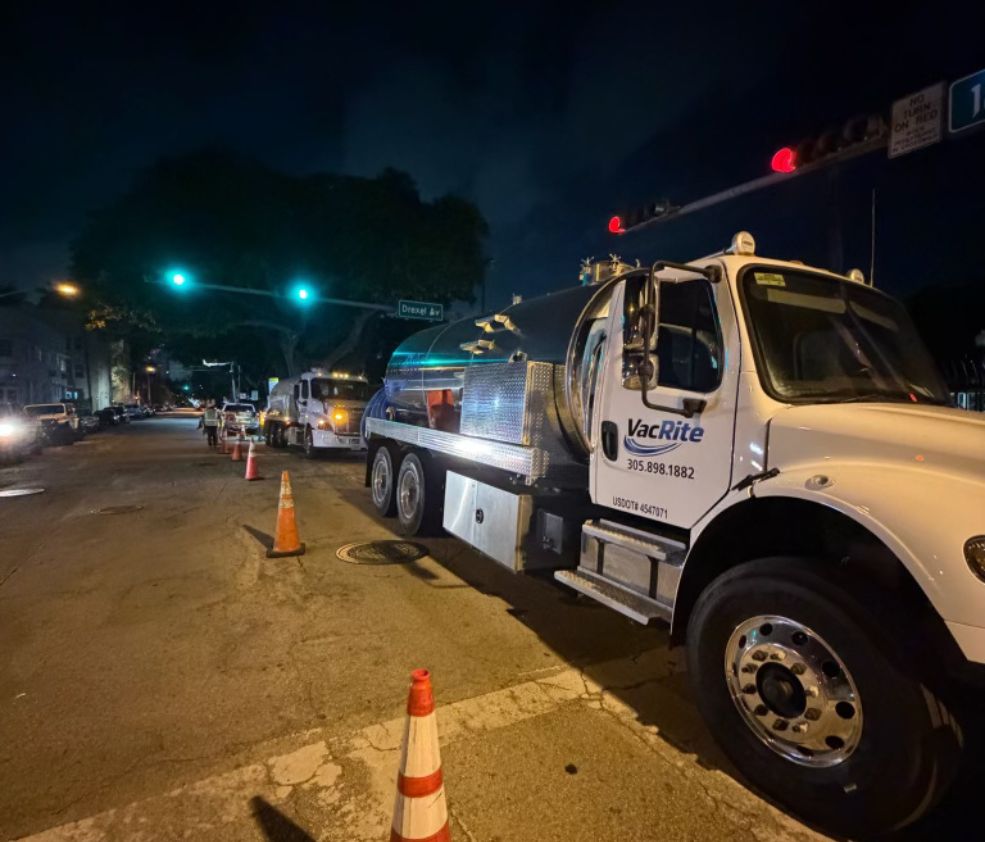
We run catch basin repair across South Florida, including Miami, Fort Lauderdale, West Palm Beach, and the rest of the region. See every city we cover or look at the trucks on the job.
Tell us what the job is
Tell us about the catch basin repair job. Where it is, what is around it, and when you need it.
Two trades, one call. We own the trucks, hold the permits, and put our own people on the job.
VacRite, Miami
info@vacriteservices.com
Open 24/7/365
USDOT 4547071