
FOG Program Compliance
Keeping a food service establishment on the right side of the fats, oils and grease rules its city or utility enforces, and keeping the file that proves it.

Restaurant owners and GMs, hotel and hospital facilities managers, supermarket and chain operations staff, school district maintenance departments, and anybody who has received a notice from a utility about their grease discharge.
How a job runs, step by step
Find out what you are actually held to
FOG requirements are set locally, so the rules for a kitchen in one South Florida city are not automatically the rules two cities over. Start from your own permit and your own utility, not from what a neighboring operator told you.
Look at the equipment you have
Trap or interceptor, where it sits, what size it is, whether the hardware inside it is intact. Half of the compliance problems we see are equipment problems wearing a paperwork costume.
Set an interval the kitchen can actually hold
Built from how your trap loads, not from a default somebody wrote on a form. An interval that gets missed is worse than a longer one that gets kept.
Service it and document it the same day
Complete pump-out, scraping, inspection, permitted disposal, manifest, photos. The record is generated by the work, not reconstructed later.
Keep one file
Manifests, disposal records, photos and service dates in one place, in date order. When an inspector asks, you hand over a folder instead of starting a search.
What a FOG program is and who runs it
FOG stands for fats, oils and grease, and a FOG program is the set of rules a city, county or water and sewer utility uses to keep those three things out of the public sewer. It exists because grease is the single most expensive thing a collection system deals with. Warm grease leaves a kitchen as a liquid, cools somewhere downstream in a public line, and hardens onto the pipe wall. Enough of it and the main blocks, which means a sanitary overflow, which means the utility is cleaning a street and answering to the state. Rather than pay for that repeatedly, utilities push the control back to the source: every food service establishment holds the grease on its own property in a trap or interceptor and has it hauled away by a permitted hauler. That is the whole logic of it. The programs are administered locally, which is the part operators get wrong most often. There is no single South Florida rulebook. Your obligations come from whichever utility your sewer connection belongs to and whichever municipality issued your permit, and those two are not always the same office. Before assuming what applies to you, read your own permit conditions and call your own utility. We are not going to quote you a section number for a city we have not read the current ordinance for, and neither should anyone else.
What a permitted food service establishment is generally expected to keep
The specifics vary by jurisdiction, but the shape of the obligation is consistent across FOG programs, and it is worth knowing in advance. You are generally expected to have a properly sized grease interceptor or trap in working order on your drain line. You are expected to have it serviced by a hauler who holds the permits to move and dispose of that waste. You are expected to keep the servicing on a defined interval rather than waiting for a problem. And you are expected to retain records showing all of it happened, usually for a period of years, on site, available when someone asks. The common working standard for the interval is service when fats, oils and grease reach roughly a quarter of the trap’s capacity, or every ninety days, whichever arrives first. Beyond about a quarter full, a trap has lost the still volume it needs for grease to rise and solids to settle, so wastewater moves through too fast to separate and grease goes out the outlet into your lateral. The rule is not bureaucratic. It is a limit on how far the equipment can drift before it quietly stops doing the job it was installed for. Some programs also require a manifest copy filed with the utility, and some require a specific reporting form. That part is genuinely local. Ask.
What an inspection actually checks
An inspector is not there to admire a clean kitchen. The visit tends to run in a predictable order. First the equipment: they want the lid off, and they want to see the trap, its condition, and how loaded it is right now. A trap sitting well over the threshold on the day of an inspection is a finding no amount of filing fixes. Second the hardware: inlet and outlet tees present and intact, baffles in place, a flow restrictor where one is required. A missing baffle means the trap has not been separating properly for however long it has been missing, and it is visible from the lid in a way a full trap is not. Third the plumbing: what is connected to the trap and what is bypassing it. A three compartment sink or a wok station plumbed around the interceptor is a serious finding, and in older buildings it is often something a previous tenant did that nobody currently on staff knows about. Fourth the records, and this is where most operators actually fail. They want dates, they want volumes, they want the name of the hauler and the disposal destination, and they want it for the whole retention period, not the last visit. Loose receipts in a drawer are not a record set. The inspection that goes badly is rarely the one where the trap was dirty. It is the one where nobody could produce last quarter’s paperwork.
Where operators get caught out
The most common trap, and it is a mean one, is inheriting a space. You take over a restaurant, the previous operator’s interceptor comes with it, and it was sized for a sandwich counter while you are running a fryer line and a griddle. It is now your non-compliance, not theirs, and undersized equipment cannot be cleaned into compliance. It just fills faster. The second is the interval that quietly slid. Service was quarterly, then somebody moved it a few weeks to fit a busy month, then again, and now it is roughly twice a year and nobody made a decision to do that. The third is the hauler who skims. If your interval keeps getting shorter and the odor comes back within days of a service, you are paying for a cleaning where only the floating layer left the box. The fourth is documentation drift: the work is being done properly and the manifests are going into three different people’s email. All four are fixable, and all four are cheaper to fix in a normal week than in the two weeks after a notice arrives. If you have already received one, say so when you call, because a kitchen under a correction deadline gets handled differently than a routine start.
Worth knowing
If a utility or city notice has already landed, read it for the deadline before anything else, and tell us what it says when you call 305-761-4311. Most notices want a documented service and a corrective plan inside a set window, and the window is usually shorter than people assume.
Ask any contractor where what they pump out actually goes. It is a fair question, and the answer tells you a lot.
VacRite
Other compliance work
The other side of the company
Most of our customers only ever need one half of what we do. It is worth knowing the other half exists.
Something failed tonight. Somebody answers.
Struck line, blocked kitchen drain, a basin backing up in the middle of a storm. We run every day of the year, and the phone reaches a person rather than a queue. This company is first responder owned, and the emergency side of it works the way that suggests.
Questions we get asked
Who sets the FOG rules for my kitchen?
Your local utility and municipality, not the state and not a national standard. That is why two operators in different South Florida cities can be held to different reporting requirements. Check your own permit conditions and call the utility that owns your sewer connection.
How long do I need to keep service records?
Retention periods are set locally and are typically measured in years rather than months. Keep everything, in one file, in date order. There is no downside to holding more than you need and a real downside to holding less.
What happens if I fail an inspection?
Usually a notice with a correction window rather than an immediate penalty, though that depends on the jurisdiction and on whether it is a repeat finding. The window is what matters. Get the service done and documented inside it and the file closes.
My trap is too small for what we cook. Is that a compliance problem?
Yes, and it is one cleaning cannot solve. An undersized interceptor reaches the threshold faster than any sensible interval, so it spends part of every cycle out of compliance. That is a sizing and installation conversation, and we would rather have it with you than watch you pay for cleanings that cannot fix it.
Do you provide manifests?
Every service, along with disposal records and before and after photos. Waste moves under our own haulers and dumping permits. That paperwork is the part inspectors actually ask for.
We got a notice and the deadline is close. Can you help?
Call 305-761-4311 and say that up front. We run around the clock and we can get a truck out for a documented service, then look at whether the underlying problem is the interval, the hardware or the size of the box.
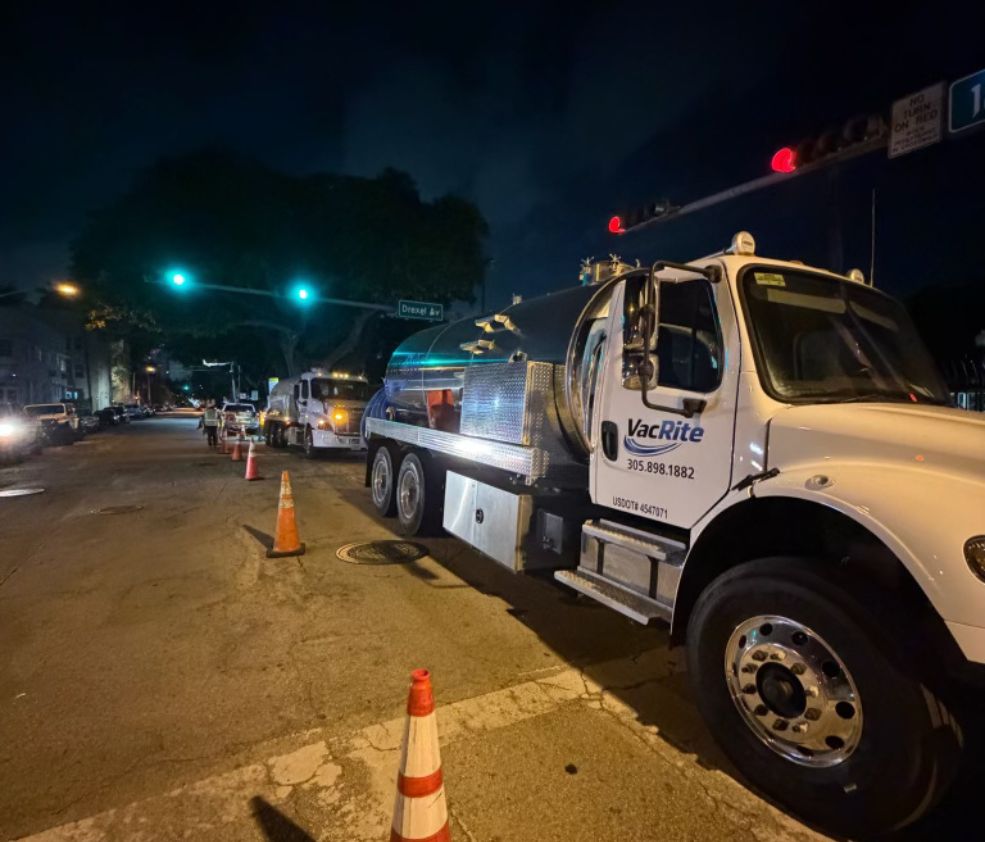
We run fog program compliance across South Florida, including Miami, Fort Lauderdale, West Palm Beach, and the rest of the region. See every city we cover or look at the trucks on the job.
Tell us what the job is
Tell us about the fog program compliance job. Where it is, what is around it, and when you need it.
Two trades, one call. We own the trucks, hold the permits, and put our own people on the job.
VacRite, Miami
info@vacriteservices.com
Open 24/7/365
USDOT 4547071