
School Grease Trap Service
Cafeteria interceptor service scheduled around the bell, the term and the summer shutdown, with the paperwork a district’s purchasing file needs.

Public school districts, charter and private schools, universities and college dining halls, daycare and early learning centers with a kitchen, and district maintenance and purchasing departments.
How a job runs, step by step
Schedule to the academic calendar
Not to the quarter. A school kitchen’s year has a shape and the interval should follow it.
Work outside the school day
After dismissal, on a weekend, or during a break. Trucks and students do not share a service drive.
Complete service and inspection
Everything out, walls and baffles scraped, and a hard look at hardware that in older buildings has not been seen in years.
Handle the procurement side properly
Purchase orders, insurance certificates, vendor registration and W-9s before the work, not after.
Deliver an audit-ready record
Manifests, disposal records and photos in a set that stands on its own when nobody involved is still in the role.
Enormous volume through a very narrow window
A school cafeteria is one of the most concentrated food service operations there is, and it is easy to underestimate because it does not look like a restaurant. A middle school serving twelve hundred students does most of that in three lunch periods inside about ninety minutes. The kitchen is producing at volume all morning, then everything hits the drains at once during cleanup, and then the building goes quiet. From the interceptor’s point of view that is a hard hydraulic slug: a large volume of hot water carrying fat and food solids arriving in a short window, with limited retention time to separate any of it. Menu matters too, and school menus have changed. A district running scratch cooking with a fryer program loads a trap in a way a heat-and-serve operation does not, and a high school with a competing snack bar or an open campus is different again from an elementary school with one seating. The practical consequence is that a school box often needs the interval set from the loading rather than from student headcount, which is the number everybody reaches for first because it is the one that is easy to look up.
Summer is not a break for the interceptor
The single most consistent scheduling mistake in school grease work is treating the summer as a gap where nothing needs to happen. It is the opposite of that. A cafeteria shuts down in June with a trap holding whatever the last week of service put into it, and then nothing flows through the box for two to three months in South Florida heat. The settled solids on the floor break down, the odor builds, floor drains in the kitchen dry out, and the smell finds its way into a building nobody is walking through to notice. Then the district restarts in August or September at full volume on day one, into a box that started the year already loaded. The right shape is a service at or just after the end of term so the structure sits empty through the shutdown, and a service before students return so the year starts clean. Districts running summer programs or feeding sites need a third look, because a partial summer operation still loads the trap and it usually falls outside whatever the school-year schedule says. Booking a routine cleaning three weeks into a break on a kitchen that closed in June is a visit nobody needed.
Old buildings, old interceptors, and what is missing inside them
A great deal of school infrastructure is decades old, and the grease interceptor is frequently original to the building. That matters in two ways. First, it was sized for the enrollment and the menu of its era, and enrollment growth or a switch to scratch cooking can leave the box undersized without anybody having made a decision. Second, the hardware inside it has usually not been inspected in a long time. A missing baffle in a 1970s school interceptor is genuinely common, and it means the trap has been passing grease into the lateral for years while looking perfectly serviced from the lid. Corroded or missing inlet and outlet tees are the same story. None of that is visible while the box is full, which is why the inspection while it is empty and lit is not a formality. There is also the plumbing question: in buildings that have been renovated repeatedly, it is worth confirming what is actually connected to the interceptor and what is bypassing it, because a fixture plumbed around the trap during some past project is a compliance problem waiting for an inspector to find it.
Procurement, purchase orders and the file that outlives everyone
District work runs on paperwork before it runs on trucks. Depending on the district there may be vendor registration, insurance certificate requirements, a W-9, a bid or quote process, and a purchase order that has to exist before a wheel turns. None of it is difficult, but all of it takes longer than people plan for, and the worst version is a kitchen with a problem in the last week of August and a purchasing process that needs three weeks. Get it started early. Send the requirements and we will put the documentation in ahead of need: bonded and insured, CDL drivers, current haulers and dumping permits. The other half of it is the record set. Public agencies get audited, and the audit typically happens long after the maintenance supervisor who ordered the work has moved to another building. The file has to make sense on its own, with dates, volumes, destinations and photos, in one consistent format across every school in the district rather than in whatever format each site’s vendor happened to use.
Worth knowing
The two visits that matter most are the one right after the last serving day and the one right before students come back. A trap left loaded through a South Florida summer with nothing flowing through it will push odor into a closed building, and the September restart hits a box that is already part full.
Ask any contractor where what they pump out actually goes. It is a fair question, and the answer tells you a lot.
VacRite
Other compliance work
The other side of the company
Most of our customers only ever need one half of what we do. It is worth knowing the other half exists.
Something failed tonight. Somebody answers.
Struck line, blocked kitchen drain, a basin backing up in the middle of a storm. We run every day of the year, and the phone reaches a person rather than a queue. This company is first responder owned, and the emergency side of it works the way that suggests.
Questions we get asked
Can you work outside school hours?
Yes, and we prefer to. After dismissal, weekends or during breaks. A vacuum truck does not belong in a service drive while students are moving.
How should a school schedule services around the calendar?
One at or just after the end of term so the box sits empty through the shutdown, and one before students return so the year starts clean. If you run summer feeding sites, add a look during the summer, because those still load the trap.
Our building is old. How do we know the interceptor is intact?
By looking at it while it is empty. Missing baffles and corroded tees are common in older school interceptors and invisible from the lid with the box full. You get photos and a written condition note either way.
Can you meet district procurement requirements?
Yes. Vendor registration, insurance certificates, W-9 and purchase order process are normal for us. Send the requirements early and we will have the documentation on file before the work is needed.
What records does the district get?
Manifests, disposal records and photos for every service, in a consistent format across every site, which is what an audit two years later actually needs.
Can you also handle catch basins and kitchen lines on campus?
Yes. Kitchen line jetting, catch basins in the bus loop and staff lot, and storm structures all run under the same permits and the same documentation, which usually means one contract instead of three.
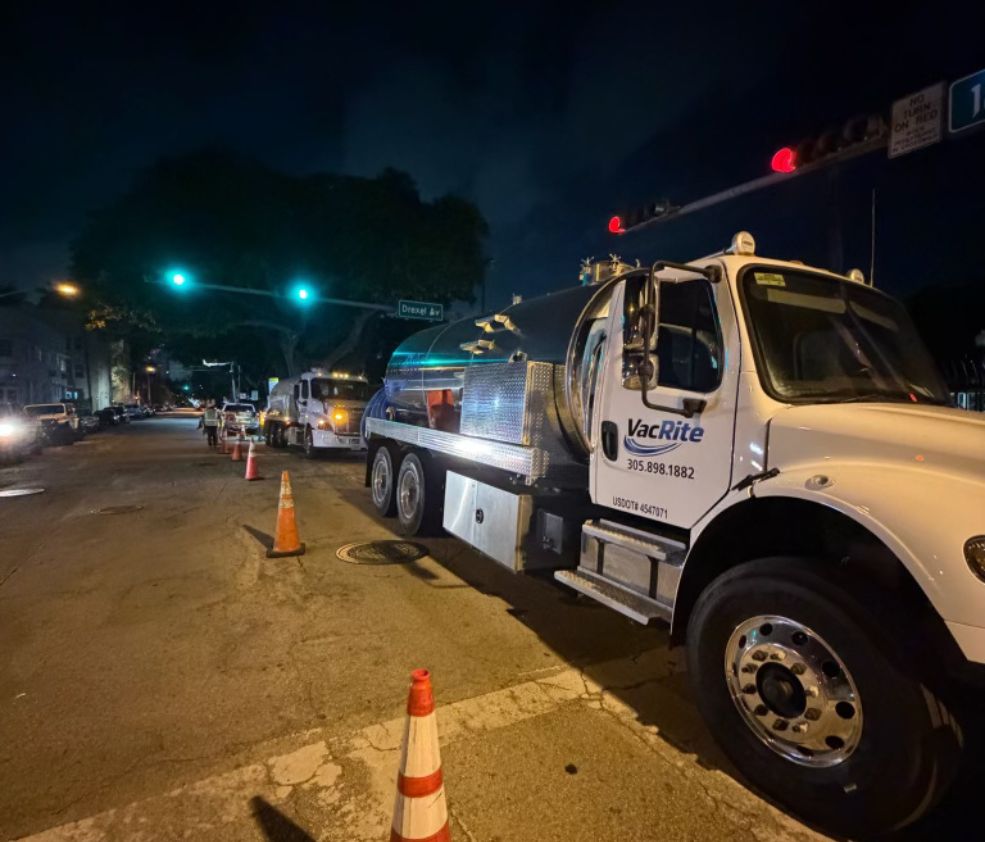
We run school grease trap service across South Florida, including Miami, Fort Lauderdale, West Palm Beach, and the rest of the region. See every city we cover or look at the trucks on the job.
Tell us what the job is
Tell us about the school grease trap service job. Where it is, what is around it, and when you need it.
Two trades, one call. We own the trucks, hold the permits, and put our own people on the job.
VacRite, Miami
info@vacriteservices.com
Open 24/7/365
USDOT 4547071