
Grease Trap Installation
Setting a new trap or interceptor and tying it into the kitchen drain line so it works the day the kitchen opens.

Restaurant build-outs, kitchen renovations, new commercial construction, food trucks converting to a fixed location, and any operation that has been told by an inspector to put a trap in.
How a job runs, step by step
Confirm the size and the placement
Before anything gets ordered, the capacity, the flow rate and the location get settled against the fixture count and against what the jurisdiction will approve. Placement has to work for the plumbing and for the truck that will service it.
Open the ground or the floor
In-ground interceptors need an excavation sized for the structure plus working room. Where the dig runs near existing utilities we open it with water and vacuum instead of a bucket, so the water service, the electrical feed and the existing sewer lateral come out of the ground untouched.
Bed and set the structure
The base gets prepared level and compacted. The tank is set, checked for level in both directions and, in the wet ground common here, held against buoyancy before backfill goes in. A tank set out of level never separates the way the rating says it will.
Plumb the inlet and outlet
Inlet and outlet lines get tied in at the correct elevations with the fall the code requires, tees set to the right depth, and a flow restrictor upstream where the fixture load calls for one. This is where most of the long-term performance is decided.
Vent it and seal it
The trap gets vented so it can breathe, because a trap that cannot vent siphons its own tees and pushes odor into the building. Every joint and penetration gets sealed against groundwater.
Test, backfill and restore
The system gets run and watched, the excavation gets backfilled and compacted, the surface goes back, and you get as-built information showing what was set, where it is and how to reach it.
Elevation is the whole job
A grease trap works because water enters, slows down, and leaves from the clean middle band while grease floats and solids settle. Every part of that depends on where the pipes sit relative to the liquid level in the box. The inlet has to deliver flow below the surface so incoming water does not plow through the floating grease cap and drive it toward the outlet. The outlet has to draw from the middle, not the top and not the floor. The liquid level itself is set by the outlet invert, which means an outlet an inch or two off the design elevation changes the working volume of the entire structure. Get it too high and the box holds more water than it was built to, with the tees sitting in the wrong band. Too low and you have paid for capacity you will never use. On top of that, the whole run has to keep the fall the code requires from the kitchen to the trap and from the trap onward, because a flat run silts up with the same solids the trap was supposed to catch. This is the part of an installation that is invisible once the backfill goes in and expensive once it is wrong.
Venting, and the traps that gurgle
A grease trap is a plumbing fixture and it has to breathe. When a slug of water from a three-compartment sink hits the inlet, it displaces air. If that air has nowhere to go, pressure pushes back through the fixture traps in the kitchen and you get gurgling drains, slow sinks and sewer gas in the room. On the back side, water leaving through the outlet can pull a vacuum that siphons the seal out of nearby floor drains, which is the other way odor gets into a dining room. Neither of those is a grease problem, and people spend months chasing them as one, having the trap pumped over and over while the smell keeps coming back. The fix is a properly sized vent on the trap and vented fixtures upstream, sorted at install. On an indoor unit that means a vent connection that actually goes somewhere rather than a cap somebody left on during rough-in. On an in-ground interceptor it means the vent riser and the manhole detail both get built the way they were drawn.
Concrete, steel and poly, and what each one does here
Precast concrete is the default for in-ground interceptors and for good reason: mass, which keeps it in place in wet ground, and durability under traffic. Its weakness is hydrogen sulfide, which forms when contents go septic and slowly eats concrete and any exposed steel, so a concrete box wants a sound interior coating and an interval that does not let it sit stagnant. Polyethylene tanks are molded in one piece, do not corrode, and handle sulfide indifferently, but they are light. In the shallow water table across much of Miami-Dade and eastern Broward, a light empty tank in saturated soil will try to float, so poly needs a deliberate anti-buoyancy detail and careful backfill rather than somebody pushing spoil back in the hole. Steel and cast iron show up mostly as indoor hydromechanical units, where they are compact and serviceable but will corrode at the waterline over years, especially in a unit that gets skimmed instead of pumped. The right material here is a function of where the trap is going, what the water table is doing at that spot, and whether a truck will be driving over it.
Placement is a service decision as much as a plumbing one
The trap gets serviced for as long as the restaurant exists, and where it sits decides how that goes. An in-ground interceptor needs a spot a vacuum truck can reach with hose to spare, not behind a dumpster corral, not under the only loading space, not on the far side of a gate somebody has the key to twice a week. Manhole covers need to be at finished grade and openable by one person with a hook, because a lid that has been paved over or blocked by a planter turns a routine visit into a demolition job. Indoor units have the mirror problem: they are easy to reach and the service happens inside the building, which means the smell and the hose run through a space where food is prepared. That pushes most operators toward servicing overnight. In older Miami storefronts and tight Broward strip centers, we have seen the ideal plumbing location be the worst possible service location, and the right answer is usually a slightly longer run to a spot the truck can actually get to.
What the inspector will be looking at
A new trap gets inspected before it is buried, so the sequence matters. What gets looked at is fairly predictable: that the unit matches the approved size, that the inlet and outlet are at the elevations on the plan, that the tees are present and set to depth, that a flow restrictor is installed where the fixture load requires one, that the structure is vented, that no prohibited fixture is tied in, and that the covers are accessible at grade. Backfilling before that inspection is how a good install turns into an excavation done twice. We build to the approved drawing, call for the inspection at the right point, and hand over as-built information afterward, so the next person to service the trap knows what is in the ground and where. Keep that packet with your service manifests. When the pretreatment program comes through, the file that has the install approval and the service records in one place ends the conversation quickly.
Worth knowing
The two things that come back to bite an install are elevation and access. A trap plumbed at the wrong invert never separates properly, and a trap the truck cannot reach never gets serviced on time.
Ask any contractor where what they pump out actually goes. It is a fair question, and the answer tells you a lot.
VacRite
Other installation work
The other side of the company
Most of our customers only ever need one half of what we do. It is worth knowing the other half exists.
Something failed tonight. Somebody answers.
Struck line, blocked kitchen drain, a basin backing up in the middle of a storm. We run every day of the year, and the phone reaches a person rather than a queue. This company is first responder owned, and the emergency side of it works the way that suggests.
Questions we get asked
How long does an installation take?
An indoor unit is usually a day or less. An in-ground interceptor depends on the excavation, the utilities in the way and the inspection schedule, and typically runs several days from opening the ground to restoring the surface.
Do we have to close the kitchen?
Rarely for the full job. The tie-in is the part that needs the drains down, and we generally do that overnight or on a closed day. Excavation and setting the structure usually happen while you are open.
Can you dig near our existing utilities?
Yes. We open those excavations with pressurized water and vacuum instead of a backhoe, which is the whole reason the method exists. The water service, electrical feed and sewer lateral come out of the ground intact.
Who pulls the permit?
The plumbing permit runs through the licensed plumbing contractor of record for the project. We have a master plumber on staff and we build to the approved drawing, and we coordinate the inspection before anything gets backfilled.
Indoor unit or in-ground interceptor?
Size usually decides it. Past the capacity a hydromechanical unit can hold, you are into an in-ground interceptor. After that it comes down to whether you have an outside location a service truck can reach.
Will the new trap float? We are close to the water table.
It will if it is set wrong. A light empty tank in saturated soil wants to lift, so it gets bedded and held down deliberately. That is standard on poly tanks here and gets checked on concrete too.
When does it need its first cleaning?
Sooner than you would think. A new trap loads fastest in the first months while the kitchen finds its rhythm, so we set a short first interval, watch what the box actually does, then settle it. Call 305-761-4311 and we will put a truck on it.
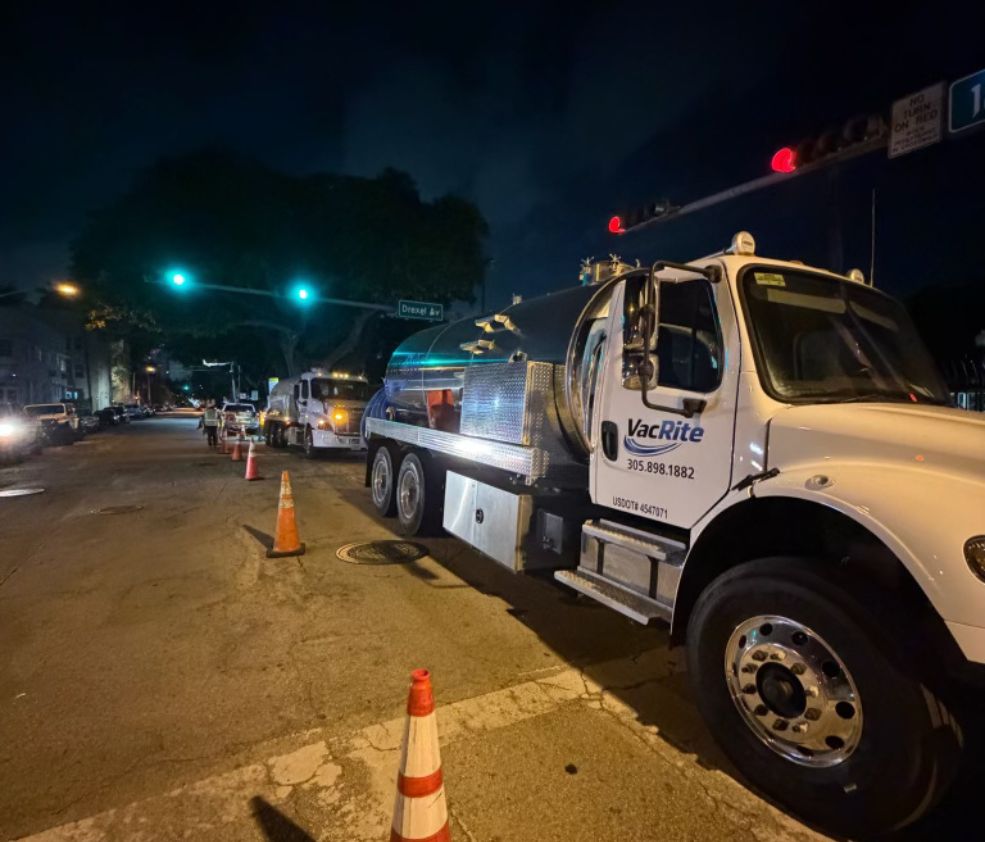
We run grease trap installation across South Florida, including Miami, Fort Lauderdale, West Palm Beach, and the rest of the region. See every city we cover or look at the trucks on the job.
Tell us what the job is
Tell us about the grease trap installation job. Where it is, what is around it, and when you need it.
Two trades, one call. We own the trucks, hold the permits, and put our own people on the job.
VacRite, Miami
info@vacriteservices.com
Open 24/7/365
USDOT 4547071