
South Miami
Excavation, grease and drainage work in South Miami, off our own trucks and answered around the clock.

Working in South Miami
We work South Miami regularly, mostly around South Dixie Highway, Sunset Drive through the downtown, and the Red Road corridor on the western edge.
A compact city wrapped around the Sunset Drive downtown with a busy federal highway and a rail corridor running straight through it, so the rights of way are narrow and crowded underground. Oolitic limestone sits shallow here and the water table is close, which means any hole opened on the downtown blocks is a wet hole in rock with other services stacked around it.
Who calls us here
A tight downtown restaurant cluster on Sunset Drive, hospital and medical office food service, and highway-corridor retail kitchens.
What we run in South Miami
The Sunset Drive downtown is a dense little restaurant run in a very small footprint, and that density is what shapes the work. Kitchens sit shoulder to shoulder sharing laterals, so a neglected trap two doors down becomes somebody else’s backup, and the property manager who calls us usually does not yet know whose problem it is. We pump the traps, jet the shared runs and keep records clean enough to settle that argument before it starts. Hospital and medical office food service adds steady high-volume accounts on their own schedule. Excavation here is potholing on the congested downtown blocks and along South Dixie, where a contractor needs a line found under sidewalk with a rail corridor and a federal highway both close enough to make an open trench a permitting problem.
Getting a truck in
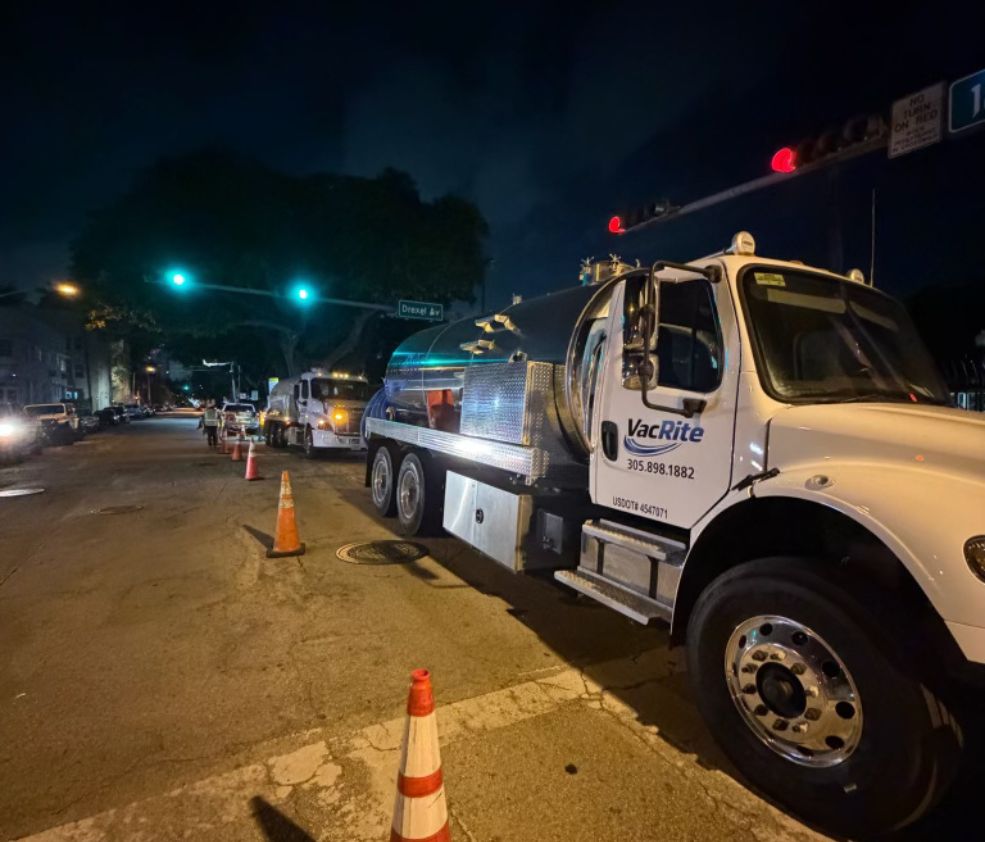
Downtown South Miami is walkable by design and there is nowhere good to put a tanker on Sunset Drive in daylight. Those kitchens get worked before opening or after close, from a rear service lane or a parking structure level, with the hose run kept short and tidy because pedestrians are through there at all hours. South Dixie carries heavy through traffic and the rail crossings can stall a route long enough to matter, so we build the day so we are not fighting one twice. Hospital service drives stay clear for emergency traffic, which means our window there is whatever gap the facility gives us. Residential streets off Red Road are quiet and narrow with a canopy worth checking before turning in.
Through the year
Restaurant volume downtown climbs through the winter and spring and eases in late summer, so trap intervals tighten in season and the deep summer is the right window for scheduled line work. The wet season loads the downtown storm inlets hard, because there is very little pervious ground in these blocks and a shallow water table under the limestone leaves the storm system doing all the work. Hurricane season brings drainage preparation across the commercial properties and the medical campuses, and afterward a stretch of clearing debris out of inlets. Institutional kitchen volume moves with the school and clinic calendar rather than the weather.
South Miami sits in Miami-Dade County, and everything on this page runs out of our yard in Miami. See the rest of Miami-Dade or look at the trucks working.
What we run in South Miami
Both halves of the company work this city. Excavation on one side, grease and drainage on the other, one phone number for both.
Also close by
We are usually working somewhere in this corner of Miami-Dade already.
One call covers both halves of the job in South Miami
Most operators working this city do one side or the other. A vacuum company that pumps grease traps generally does not daylight a gas service, and an excavation outfit generally does not want to hear about your kitchen line. We run both off the same yard in Miami, with the same trucks and the same permit set.
A new catch basin is the clearest example. Setting the structure is drainage work, but the hole it goes into sits at the low point of a lot, which is exactly where irrigation, lighting conduit and sleeves tend to run. Somebody has to expose those before a bucket finds them. One call, one crew, and nobody pointing at the other guy.
The same logic runs the other way. A restaurant with a line that keeps blocking has a jetting problem and a trap interval problem, and treating either one alone means doing it again in a few months. Because the crew that clears the line is the crew that services the trap, the conversation covers both instead of stopping at the edge of somebody’s scope.
What you get in writing
Every environmental service in South Miami generates a manifest showing what came out and where it went, before and after photographs, and disposal records from an approved facility. That file is what an inspector asks for, and it is the reason the haulers permit and the dumping permit matter rather than being background detail.
On the excavation side the deliverable is different but the principle is the same. An exposed utility gets measured for depth and offset, identified by size and material, and photographed, so the drawing can be corrected before a trench crew corrects it the expensive way. Everything we run is available across this area, and telling us the job is the fastest way to find out which part of it you actually need.

Something failed tonight in South Miami. Somebody answers.
Struck line, blocked kitchen drain, a basin backing up in the middle of a storm. We run every day of the year, and the phone reaches a person rather than a queue. This company is first responder owned, and the emergency side of it works the way that suggests.
Questions we get asked
Do you charge extra to come out to South Miami?
South Miami is inside the area we run. Tell us the job and we will tell you plainly whether it makes sense for us to be the ones doing it.
How fast can you get a truck to South Miami?
Depends what is already running and where you are. Call and you will get a real answer rather than a maybe. We run every day of the year.
Do you service both restaurants and construction sites in South Miami?
Both. Grease traps and cooking oil on one side, excavation and utility work on the other, out of the same yard.
Do you work nights here?
Regularly. Most kitchen work in South Miami happens after close, and a lot of utility work has to happen off-peak.
What paperwork do we get?
Manifests, disposal records and photos on the environmental side, and measured, photographed utility records on the excavation side.
Tell us what the job is
Tell us where in South Miami the job is and what is going on.
Two trades, one call. We own the trucks, hold the permits, and put our own people on the job.
VacRite, Miami
info@vacriteservices.com
Open 24/7/365
USDOT 4547071