
Hospital Grease Trap Service
Interceptor service for hospitals and healthcare campuses, where the kitchen never closes, the route through the building is controlled, and the crew has to be credentialed to be there at all.

Hospitals, medical centers, surgical and specialty facilities, long term care and skilled nursing homes, assisted living communities, and healthcare facilities and environmental services departments.
How a job runs, step by step
Clear credentialing first
Vendor registration, insurance, badging and any health system requirements handled before a truck is scheduled.
Agree the route and the window
Where the truck stages, which doors and corridors the crew uses, and who escorts. Agreed with facilities, not improvised on the day.
Service without stopping the kitchen
A hospital kitchen does not close, so the work fits the quietest window rather than a shutdown.
Full pump-out, scrape and inspection
Complete removal, walls and baffles scraped, hardware and structure inspected and photographed.
Document to the facility’s standard
Manifests and disposal records in the format your environment of care file expects.
A kitchen with no closed hours
Every other food operation has a bottom of the cycle. A restaurant closes, a school empties, a hotel banquet kitchen goes dark between events. A hospital kitchen does not. It runs three patient meal services, a cafeteria that feeds staff and visitors across the day, and overnight food for shift workers and family in waiting areas. Retention time in an interceptor depends on flow slowing down enough for grease to rise and solids to settle, and in a kitchen with no closed period the box never gets a long quiet stretch to do that. It also means there is no true shutdown window to service in. What there is instead is a quietest window, usually deep overnight between the end of dinner cleanup and the start of breakfast prep, and it is short. Planning for that is the whole game. Trying to fit a hospital interceptor into a normal commercial service slot does not work, and neither does assuming the kitchen can pause the way a restaurant can. The other consequence is that patient feeding cannot be interrupted, which raises the cost of a mistake: a line taken down at the wrong moment is not an inconvenience, it is a clinical services problem.
Infection control governs where the crew can go
This is the part that genuinely separates healthcare work from every other kitchen account, and it is the part outside contractors most often get wrong. A hospital controls movement through the building for clinical reasons. There are corridors that are patient transport routes, elevators that are clinical only, areas under construction with infection control risk assessment barriers in place, and units where nobody walks through without a reason and an escort. A vacuum hose run across the wrong corridor is not a housekeeping complaint, it is a control failure. The workable approach is to agree the route in advance with facilities or environmental services: where the truck stages, which service entrance is used, which path the hose takes, what gets protected, who escorts, and what the cleanup standard is when the work is finished. It should be written on the work order. If the interceptor is inside the building rather than in an exterior lot, that conversation is not optional. We would rather spend twenty minutes on it before the first visit than have a crew improvising a route past a unit at three in the morning.
Credentialing is a prerequisite, not paperwork
Health systems generally require vendors to be registered and individual workers to be credentialed before they set foot on a campus, and depending on the system that can include background checks, badging and immunization records, sometimes through a third-party vendor credentialing service. That takes real time. The mistake is treating it as something to sort out when there is a problem, because a hospital with a backing-up kitchen line at midnight cannot credential a crew at midnight. Getting it done during a routine start is what makes an emergency call answerable later. Because we own the trucks and run our own crews rather than brokering the work to whoever is free, the people who arrive are the people already on your file, which is the whole point of doing the credentialing in the first place. A subcontracted driver whose name is not on the list is turned away at the gate, and correctly so. We are bonded and insured with CDL drivers and current haulers and dumping permits, and we will work through whatever registration process your facility uses.
Long term care and the buildings that are quietly food service
Skilled nursing, assisted living and long term care facilities sit in an awkward gap. They are not hospitals and they are not restaurants, but they run a full kitchen serving three meals a day, every day, to a resident population that cannot skip a meal. Many of them are older buildings with an interceptor sized when the facility was built and a resident count that has grown since. The staffing is also different: there is often no dedicated facilities engineer, and grease service ends up owned by an administrator or a dietary manager who has plenty of other responsibilities and no particular reason to know what a baffle does. That combination produces the failures we see most often in that setting, which are intervals that quietly stretched and hardware nobody has looked at. It is worth someone opening the box and saying plainly what is in it and what condition it is in. The same is true of the compliance file. These facilities are inspected on several fronts, and a clean, dated, photographed grease record is one less thing to explain.
Worth knowing
Sort credentialing and the agreed route on a routine visit, not during an emergency. A hospital that needs a truck at two in the morning cannot badge a crew at two in the morning, and a driver who is not already on the vendor list gets turned around at the gate, which is exactly what the list is for.
Ask any contractor where what they pump out actually goes. It is a fair question, and the answer tells you a lot.
VacRite
Other compliance work
The other side of the company
Most of our customers only ever need one half of what we do. It is worth knowing the other half exists.
Something failed tonight. Somebody answers.
Struck line, blocked kitchen drain, a basin backing up in the middle of a storm. We run every day of the year, and the phone reaches a person rather than a queue. This company is first responder owned, and the emergency side of it works the way that suggests.
Questions we get asked
Our kitchen never closes. When do you service?
In the quietest window, usually deep overnight between the end of dinner cleanup and the start of breakfast prep. We run 24/7/365 and we plan the visit around patient feeding rather than asking the kitchen to stop.
Can you meet our vendor credentialing requirements?
Yes. Vendor registration, insurance certificates, background checks and badging are normal for healthcare accounts. Start it at the routine stage so an emergency call is answerable later.
How do you handle infection control and routes inside the building?
By agreeing the route before the visit with facilities or environmental services: staging point, service entrance, hose path, protection, escort and cleanup standard, written on the work order rather than decided on the night.
Do you work with long term care and assisted living facilities?
Yes. They run a full kitchen every day of the year and frequently on original equipment, and they are often the accounts where nobody has opened the box in a long time.
What if a kitchen line backs up during a shift?
Call 305-761-4311. We are around the clock and we own the trucks, so the crew that arrives is the crew already on your vendor file.
What documentation do we receive?
Manifests, disposal records and before and after photos every service, in a format that fits an environment of care file and holds up in an audit.
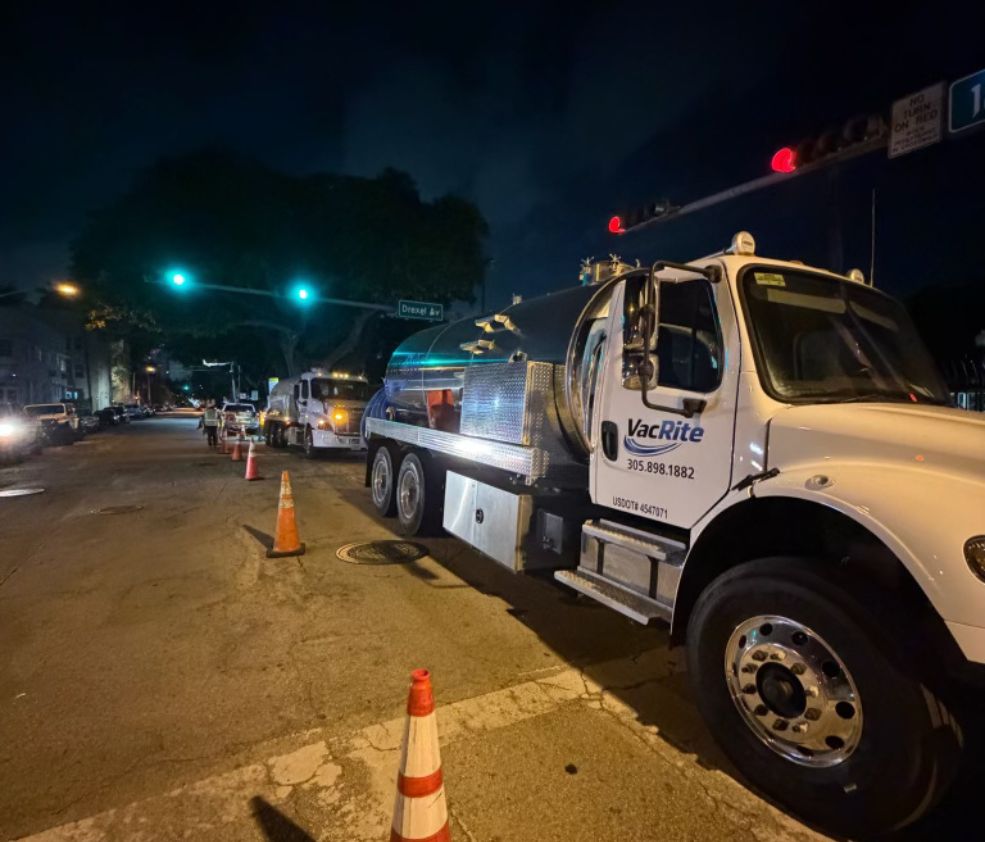
We run hospital grease trap service across South Florida, including Miami, Fort Lauderdale, West Palm Beach, and the rest of the region. See every city we cover or look at the trucks on the job.
Tell us what the job is
Tell us about the hospital grease trap service job. Where it is, what is around it, and when you need it.
Two trades, one call. We own the trucks, hold the permits, and put our own people on the job.
VacRite, Miami
info@vacriteservices.com
Open 24/7/365
USDOT 4547071