
Restaurant Grease Trap Service
Grease trap service built around how a restaurant kitchen actually loads a trap, shift by shift, without shutting down the line.

Independent restaurants, franchise locations, bars with a kitchen, cafes, pizzerias, wok and griddle kitchens, and food halls where several concepts share one trap.
How a job runs, step by step
Time it to your service
Late night after close or early morning before prep. The goal is a trap serviced and a kitchen that opens on time.
Take everything out
Grease cap, water column and the settled solids off the floor. A skim leaves the layer that rots and shortens your next interval.
Scrape it down
Hardened grease on walls and baffles is a head start on the next accumulation. It comes off while the box is empty.
Read the loading
How deep the cap is, how much solid is on the floor, and how those numbers moved since last time. That is what sets your real interval.
Leave the file complete
Manifest, disposal records and photos before we pull off the lot.
A fryer line is the whole story
Restaurants do not load traps evenly, and the fryer line is usually the reason. A griddle and a fryer bank throw off warm fat continuously through service, and every wipe-down, every pan rinse and every mop bucket carries some of it into the drain. A kitchen with two fryers and a flat top will load a trap several times harder than a kitchen with the same seat count running a cold and grilled menu, even though on paper they look like similar businesses. Wok kitchens are their own category again, because the oil volume per dish is high and it goes down the drain hot and stays liquid well past the trap inlet. What that means practically is that the trap interval on your lease paperwork or your previous operator’s schedule is close to meaningless until somebody has actually opened your box after a normal week. We would rather set your interval off two real services than off a category. If the grease cap is deep and the floor is loaded at ninety days, you need to be inside ninety. If the box is barely working at ninety, we will tell you that too, because paying for a cleaning you did not need is not a service.
One shift versus two, and what it does to the box
The single biggest swing we see in restaurant loading is whether the kitchen runs one service or two. A dinner-only house has a hard load for four or five hours and then a long quiet stretch where the trap sits still and does exactly what it is designed to do: let grease rise, let solids settle, let clean water move out the middle. A breakfast through dinner operation never gets that. The box is being fed most of the day, the flow rarely stops long enough for a full separation cycle, and the trap spends its life closer to the edge of working than a straight volume comparison would suggest. Add a weekend brunch that doubles covers and you have a box that behaves differently on a Monday than it does on a Friday. This is also why a trap can pass an inspection on a slow Tuesday and back a line up the following Saturday. If you have added a service since your interval was set, opened for lunch, taken on catering, started a late night menu, that is the moment to have the interval looked at again rather than eighteen months later.
The trap you inherited was sized for a different menu
This is the most common structural problem in restaurant grease work, and it is almost never the current operator’s fault. Interceptors get sized when a space is built out, for whatever concept was going in at the time. Then the space turns over. A cafe becomes a burger house. A sandwich counter becomes a fryer-heavy concept with a smoker. The interceptor does not change, because changing it means opening the floor or the lot, and nobody wants that during a build-out. So you end up cooking a menu the box was never sized for. The symptoms are consistent: an interval that keeps shrinking, a trap that is over the threshold well before the ninety day mark, odor coming back within days of a good service, and eventually a slow line. No cleaning schedule fixes an undersized interceptor, because the problem is capacity and time, not maintenance. What we can do is tell you honestly which one you have. If the box is genuinely too small for the kitchen, you are better off knowing that and planning a replacement than paying to pump an undersized trap every six weeks forever.
Working a live restaurant without wrecking the night
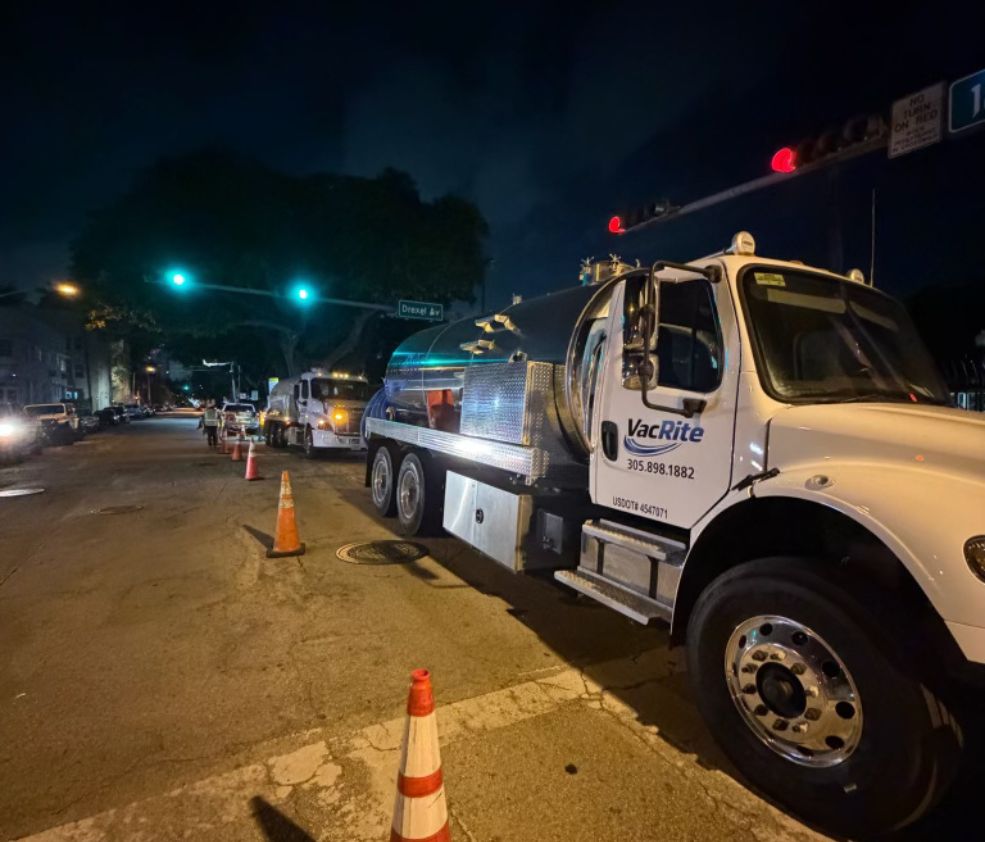
Nobody wants a vacuum truck outside their front door at seven on a Friday. Restaurant service is almost always after close or before prep, and there is a real difference between the two. After close is easier on the kitchen but means the crew is working around a cleanup and sometimes a staff meal. Before prep is cleaner but the clock is hard, because a produce delivery or a first cook walking in at six ends the window whether we are finished or not. Either way, the things that turn a smooth service into a bad one are boring and predictable: a trap lid buried under stacked crates, a car parked over the interceptor in the back lot, nobody on site with a key to the gate. Tell us where the box is and how the truck reaches it when you book, and if the lid is in a walkway or under a mat, say so. We run around the clock, which is the point of doing it this way, but a hose has a length and a truck has a turning circle.
Worth knowing
Watch the interval, not the calendar. If the time between services keeps getting shorter, something changed: a new menu item, a new shift, a hauler skimming the top, or a baffle that is no longer there. Any of those is worth a phone call before it is worth a plumber.
Ask any contractor where what they pump out actually goes. It is a fair question, and the answer tells you a lot.
VacRite
Other compliance work
The other side of the company
Most of our customers only ever need one half of what we do. It is worth knowing the other half exists.
Something failed tonight. Somebody answers.
Struck line, blocked kitchen drain, a basin backing up in the middle of a storm. We run every day of the year, and the phone reaches a person rather than a queue. This company is first responder owned, and the emergency side of it works the way that suggests.
Questions we get asked
Can you service us after close?
Yes. Most of our restaurant work runs overnight or early morning, and we are staffed around the clock. Tell us your window when you book and we will fit it.
How often should a restaurant trap be cleaned?
The working standard is at a quarter of capacity or every ninety days, whichever comes first, but a fryer-heavy kitchen running two services can hit that well inside three months. We would rather set your interval from what your box actually does over a couple of visits.
Our trap fills up faster than it used to. What changed?
Usually one of three things: the menu or the shift pattern changed, the last service only took the floating layer and left the solids, or a baffle or tee has failed so the trap is no longer separating. All three are visible with the box empty.
Do you handle small under-sink traps as well as in-ground interceptors?
Yes, both. A lot of smaller kitchens and food hall stalls run on an under-sink unit and those still need complete service and a record.
We share an interceptor with other tenants. Does that work?
It does, and it is common in food halls and strip centers, but it complicates the interval because your load is not the only load. We can service it as one job and document it so each tenant has the record their own permit requires.
What do we get for our compliance file?
A manifest, disposal records and before and after photos every visit. Waste moves under our own haulers and dumping permits.
We run restaurant grease trap service across South Florida, including Miami, Fort Lauderdale, West Palm Beach, and the rest of the region. See every city we cover or look at the trucks on the job.
Tell us what the job is
Tell us about the restaurant grease trap service job. Where it is, what is around it, and when you need it.
Two trades, one call. We own the trucks, hold the permits, and put our own people on the job.
VacRite, Miami
info@vacriteservices.com
Open 24/7/365
USDOT 4547071