
Emergency Grease Trap Service
A truck out now when the trap has overflowed, the kitchen drains have stopped or an inspector is standing there, any hour, any day.

Restaurants backing up during service, hotels and hospitals that cannot close a kitchen, property managers with wastewater on a floor, and operators with a health inspector on site right now.
How a job runs, step by step
Take the call and get the facts
Where the water is, whether the kitchen is running, what the trap is and where a truck can get to it. Two minutes on the phone decides whether this is a pump-out, a blockage or both.
Roll a truck
We run 24/7/365. The call is answered by somebody who can put a truck on it, not by a service that takes a message for the morning.
Stop the overflow
First priority is getting the wastewater off the floor and the level in the box down so nothing more comes up through the fixtures or the floor drains.
Find out why it happened
An overflow is a symptom. Overloaded trap, blocked outlet line, downstream lateral blockage and a failed internal all look similar from the kitchen and need different work.
Clear the line if that is the problem
Where the restriction is in the inlet or outlet line, it gets hydro-cleaned rather than poked at, so the pipe comes back to full bore instead of a channel through the buildup.
Clean up, document and tell you the truth
The trap gets fully pumped, the area gets cleaned down, you get a manifest and photos, and you get a straight account of the cause so it is not a monthly event.
What is actually happening when it backs up
The kitchen sees the same thing almost every time: sinks that will not drain, water coming up out of a floor drain, sometimes grease-laden wastewater spreading across the line. Underneath, it is usually one of four things. The trap is full past the point where it has any working volume, so incoming flow has nowhere to go. The outlet line from the trap has closed down with cooled grease, which happens gradually and then finishes suddenly. The lateral downstream is blocked, in which case the trap is full because it cannot discharge and pumping it buys you an hour at most. Or an internal has failed in a way that has restricted flow through the box. Telling them apart on site is straightforward once the covers are off. If the trap is at or above the outlet invert and stays there after pumping, the problem is downstream. If it draws down and refills from the kitchen normally, the problem was capacity or the inlet side. Getting that right in the first twenty minutes is the difference between fixing it tonight and being back on Friday.
Why the 2am call is almost always an interval problem
Emergencies at grease traps are rarely random. Walk back through the history on almost any overflow and you find a service interval that was too long, or a run of pump-outs that took the top and left the floor, or a hardware failure that nobody looked for because the trap was never emptied enough to see it. The box does not fail suddenly. It loses working volume steadily, separates worse and worse, sends grease down the lateral for weeks, and then one busy Friday the accumulated restriction and a full dish station arrive at the same moment. That is why the useful part of an emergency call is not the pump-out, it is the explanation afterward. We measure what was in the box, look at the internals while it is empty, and tell you whether this was loading, hardware or a line. Then the interval gets set from that. An operator who gets one overflow and fixes the cause generally does not see another. An operator who gets pumped and moves on tends to see us again in about the same number of weeks.
The line, and why rodding it is not the same as cleaning it
When the restriction is in the pipe rather than the box, how it gets cleared matters more than most people expect. Cooled grease lines the inside of a pipe the way scale lines a kettle, closing the bore from all sides over months. Push a cable through that and you get a channel: the water runs again, the kitchen is happy, and the pipe is still mostly full of grease with a hole through the middle of it. That hole closes back up, and it closes faster than the original buildup took because the surface is already rough. Hydro-cleaning is different. Water at pressure cuts the deposit off the pipe wall and flushes it back to where it can be vacuumed out, so the pipe comes back to something near its actual diameter. The tell that somebody has been rodding a grease line for years is a customer who says the drain gets cleared every few months. That is not maintenance, that is a pipe that has never actually been cleaned. It also means grease is getting into the lateral in the first place, which points back at the trap.
Getting a truck there, and what slows it down
We run 24/7/365 and the phone gets answered by somebody who can put a truck on it rather than take a message. What determines how fast the work actually starts is usually not the drive, it is what waits at the other end. Access covers that have been paved over, a dumpster corral built across the service point, a locked gate with the key at a manager’s house, a delivery van parked on the lid: every one of those has cost real time on a real call. So has nobody on site knowing where the trap is, which happens more often in multi-tenant properties and food halls than you would think. The five minutes worth spending before an emergency ever happens: know where your trap is and how a truck reaches it, keep the covers clear and openable, and have the after-hours contact for the property somewhere the night manager can find it. When you call 305-761-4311 at two in the morning, being able to answer where it is and how to get to it is what puts a hose in the box soonest.
The inspector version of an emergency
Not every urgent grease call involves water on a floor. A health inspector or a pretreatment officer standing in the kitchen looking at an overdue trap is its own kind of emergency, and it comes with a clock on it. Those calls generally need two things quickly: the trap serviced properly, and a document proving it. We can get a truck out and get the box fully pumped and scraped, and the manifest, before and after photos and disposal records come with it under our own haulers and dumping permits. Where there is a gap in the file behind it, we say so rather than pretending otherwise, and the condition of the trap gets recorded that day as the starting point of a clean record. The thing worth understanding is that an inspection almost never goes badly because a trap was dirty on the day. It goes badly because there is no history showing it is ever anything else. Getting on a documented interval right after one of these visits is what makes the follow-up a five minute conversation.
Worth knowing
If your trap backs up more than once, stop treating it as an emergency and get the cause identified. Repeat overflows are an interval, a hardware failure or a line, and pumping alone fixes none of them.
Ask any contractor where what they pump out actually goes. It is a fair question, and the answer tells you a lot.
VacRite
Other grease work
The other side of the company
Most of our customers only ever need one half of what we do. It is worth knowing the other half exists.
Something failed tonight. Somebody answers.
Struck line, blocked kitchen drain, a basin backing up in the middle of a storm. We run every day of the year, and the phone reaches a person rather than a queue. This company is first responder owned, and the emergency side of it works the way that suggests.
Questions we get asked
How fast can you get here?
We run 24/7/365 and the phone is answered by somebody who can put a truck on it. Call 305-761-4311 and tell us where the trap is and how a truck reaches it, and we will give you a real arrival time rather than a window.
Our sinks have stopped and water is coming up the floor drain. What do we do first?
Stop putting water down the line, which means the dish station and the prep sinks, and call. Running more water into a system that cannot discharge is what turns a backup into a flooded kitchen.
Do we have to close?
Not always. If the trap is simply overloaded, a pump-out gets you running again quickly. If the blockage is downstream in the lateral, the drains stay unusable until the line is clear, and that takes longer.
Why did this happen? We just had it pumped.
Usually because the pump-out left the solids layer on the floor, because an internal has failed, or because the blockage is in the line rather than the box. We open it, look, and tell you which one it was.
Do you clear the drain lines too?
Yes. Where the restriction is in the inlet or outlet line we hydro-clean it, which cuts the deposit off the pipe wall. Running a cable through cooled grease only makes a channel that closes back up.
Can you come out at night or on a holiday?
Yes. Nights, weekends and holidays are when most of these calls come in, because that is when kitchens are busiest. We are first responder owned and we staff for it.
An inspector is here right now and our trap is overdue.
Call and say exactly that. We can get a truck out, service the trap properly and give you the manifest, before and after photos and disposal records that day, which is usually what the officer is asking to see.
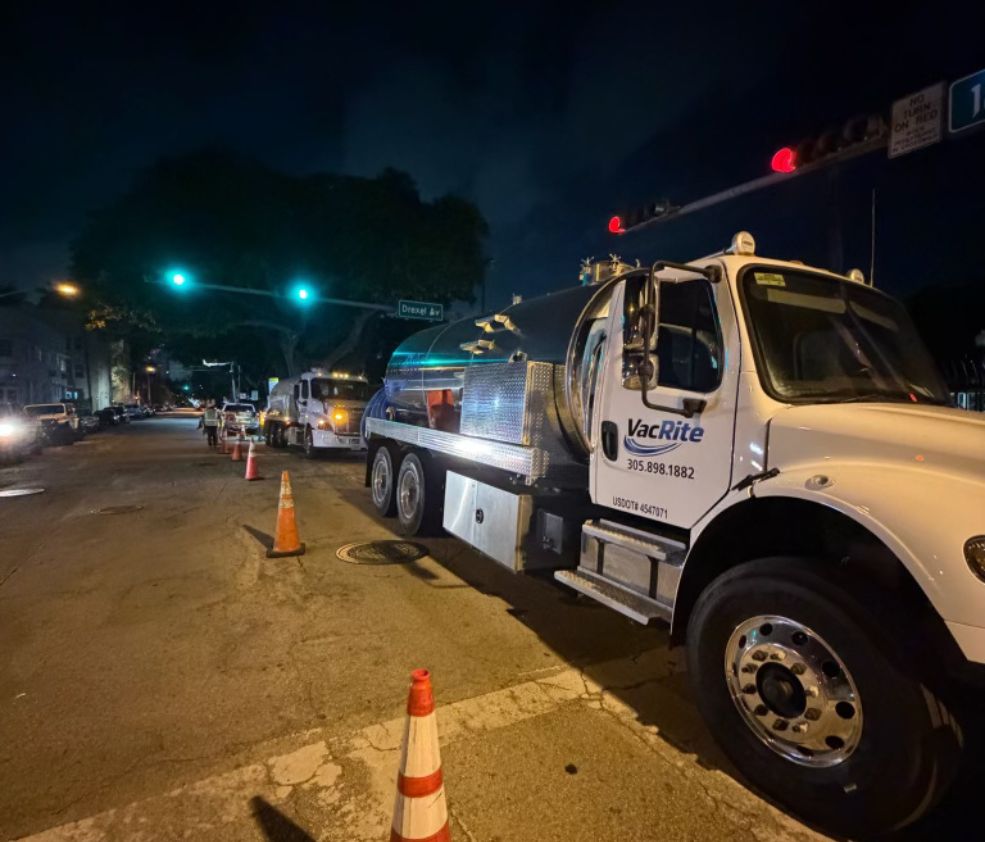
We run emergency grease trap service across South Florida, including Miami, Fort Lauderdale, West Palm Beach, and the rest of the region. See every city we cover or look at the trucks on the job.
Tell us what the job is
Tell us about the emergency grease trap service job. Where it is, what is around it, and when you need it.
Two trades, one call. We own the trucks, hold the permits, and put our own people on the job.
VacRite, Miami
info@vacriteservices.com
Open 24/7/365
USDOT 4547071