
Under Sink Grease Trap Service
Cleaning and servicing of the small point-of-use trap that sits under a sink or next to a dish machine, inside the kitchen, where the grease enters the drain.

Small restaurants, cafes, bakeries, coffee shops, delis, food trucks with fixed commissary sinks, bars with a food menu, break room kitchens in office and industrial buildings, and any tenant space with no room outside for an in-ground structure.
How a job runs, step by step
Work around the fixture, not through it
The unit lives in the busiest square footage in the building. Floor gets protected, the area around the trap gets cleared, and the work happens in a window when the line is down.
Open and read it
Cover comes off, gasket and hardware get checked, and grease depth and solids depth get read before anything is removed. On a small unit those numbers move fast and they are the whole story of whether the interval is right.
Empty the unit completely
Grease, water and the solids on the floor of the unit all come out. On a unit this size a partial service is not a shortcut, it is most of the job left undone.
Scrape and clean the internals
Baffles, the flow diffuser, the strainer basket and the walls get scraped and wiped down. Small units have tight internals and hardened grease bridges them quickly.
Reseat the cover properly
The gasket has to seal or the unit will smell and can siphon. A cracked or flattened gasket gets flagged, and a missing hold-down bolt gets flagged louder.
Haul away and document
Waste leaves the property with us to an approved facility, with a manifest and photos, exactly the same chain as a large structure.
Point of use is the whole idea
An under-sink unit is not a small interceptor. It is a different strategy. An interceptor waits outside and catches grease after it has traveled the building’s drain line, cooled, and had a chance to stick to the inside of every pipe on the way. A point-of-use trap catches it at the fixture, a few feet from where it came off the pan, while it is still hot and still moving. That is the argument for the small unit and it is a good one, because the grease that never enters your building drain line is grease that never has to be jetted out of it later. The tradeoff is that it only protects the fixture it is plumbed to. A trap under the three compartment sink does nothing for the wok station across the kitchen or the floor drain by the fryer, and a lot of kitchens discover this after a remodel moved the cooking and left the plumbing where it was. When we walk a small kitchen the first thing worth establishing is not the condition of the trap. It is which fixtures actually run through it, because that determines whether the unit is protecting the kitchen or protecting one sink while everything else drains straight to the lateral.
The most commonly mis-specified piece of equipment in a kitchen
Undersized point-of-use traps are everywhere, and the reason is structural rather than careless. The unit gets specified once, at build-out, against the fixtures on the plan and a rated flow the designer worked out on paper. Then the kitchen opens and reality diverges. A second sink gets tied in. A dish machine gets added or replaced with a faster one that discharges a large volume in a short burst. The menu changes, a fryer program appears, prep volume triples. None of those changes prompt anybody to revisit a beige box under a sink. The failure mode is specific and worth recognizing, because it does not look like a full trap. An undersized unit is overwhelmed by flow rate, not by accumulation. Water moves through it faster than the retention time the unit was built around, so grease never gets the seconds it needs to rise, and it exits with the water while the trap sits half empty and looks perfectly healthy. The tells are a kitchen with a small trap that never seems to fill but has a lateral that keeps needing attention, grease showing up downstream of a unit that was serviced last month, and a dish machine dumping into a unit rated for a hand sink. The fix is not a shorter interval. A shorter interval does nothing about flow rate. The fix is the right size unit, or a flow control device that meters the discharge so the trap gets the retention time it was designed for.
Small units, tight spaces and the practical realities
The unit is under a sink in a working kitchen, which shapes everything about the visit. Clearance is measured in inches. There is usually a disposal, a p-trap, a water filter and a shelf of chemicals sharing the cabinet. The floor is finished and the kitchen has to open in the morning. So the work runs tight and clean: the area gets covered, the hose run gets planned before anything is opened, and the unit gets emptied rather than dragged out into the room. Odor is the reason kitchens notice these units at all, and odor almost always comes from the same two places, which are the solids left on the floor of the unit by a partial service and a cover gasket that no longer seals. Both are cheap to get right and both are routinely missed. The hardware inside is small enough that it fails quietly: a strainer basket somebody threw away because it was inconvenient, a baffle that corroded off its mount, a flow diffuser knocked loose. Any of those turn the unit into a small holding box that passes grease straight through, and none of them are visible unless somebody actually looks while it is empty.
What goes into it upstream decides how often we come
On a unit this small, kitchen habits move the interval more than anything else. A sink strainer that is actually used keeps food solids out of the trap and can meaningfully extend the time between services. Scraping pans into the trash rather than rinsing them into the drain does more for a small trap than any product on the market. Hot water and detergent are worth understanding properly, because a heavy hot rinse emulsifies grease and pushes it through the unit still suspended in the water, and it then cools and drops out somewhere further down the line where you have no access to it. That is the actual mechanism behind a kitchen that religiously services a clean-looking trap and still has a lateral that blocks every spring. Enzyme and bacteria products sold for traps deserve a plain answer too. They do not remove grease from your building. At best they break it up, and broken up grease is grease that leaves the trap and reassembles in the collection system, which is why a lot of jurisdictions in this state prohibit them outright. There is no product that empties a trap. A truck empties a trap. Call 305-761-4311 and we will get a truck out for the unit you have.
Worth knowing
If your under-sink unit never seems to fill up but the line downstream keeps giving you trouble, stop assuming the trap is fine. That pattern is the signature of a unit undersized for the flow hitting it, and no service interval fixes a flow rate problem.
Ask any contractor where what they pump out actually goes. It is a fair question, and the answer tells you a lot.
VacRite
Other grease work
The other side of the company
Most of our customers only ever need one half of what we do. It is worth knowing the other half exists.
Something failed tonight. Somebody answers.
Struck line, blocked kitchen drain, a basin backing up in the middle of a storm. We run every day of the year, and the phone reaches a person rather than a queue. This company is first responder owned, and the emergency side of it works the way that suggests.
Questions we get asked
How often does an under-sink trap need service?
More often than a large interceptor, because there is far less volume to fill. Many small kitchens land somewhere in the monthly range and some busy ones run shorter than that. We would rather read your actual depths over two or three visits than hand you a number on day one.
Can we clean it ourselves?
Some operators do, and the grease still has to go somewhere legal. That is the part that catches people, because grease is a regulated waste, it does not belong in a dumpster or a floor drain, and there is no manifest at the end of a DIY. It is also the version where nobody scrapes the baffles or looks at the hardware.
Will you have to shut down our kitchen?
Not the whole kitchen. The fixture that drains through the unit is out of service for the visit, which is why most small kitchens put us in before opening or after close. We run around the clock, so pick the window that costs you nothing.
How do I know if ours is too small?
The classic sign is a trap that stays low while grease keeps showing up downstream of it. Beyond that, check what actually drains into it. A unit sized for a hand sink at build-out and now taking a dish machine or a second prep sink is undersized regardless of what the original plan said.
Do enzyme or bacteria additives reduce how often we need service?
No. They do not take grease out of the building, they just break it up so it leaves the trap and re-forms further down the line. Several jurisdictions in this state prohibit them for exactly that reason. The only thing that empties a trap is a truck.
Our unit smells even right after a cleaning. Why?
Two usual causes. The solids on the floor of the unit were left behind by a partial service and they are what rots, or the cover gasket is flattened or cracked and no longer sealing. Both get checked and reported on our visits.
Do we still get a manifest for a small unit?
Yes. Volume does not change the obligation. The waste goes to an approved facility under our haulers permit and dumping permit, and you get the manifest, the disposal record and photos, same as a large interceptor.
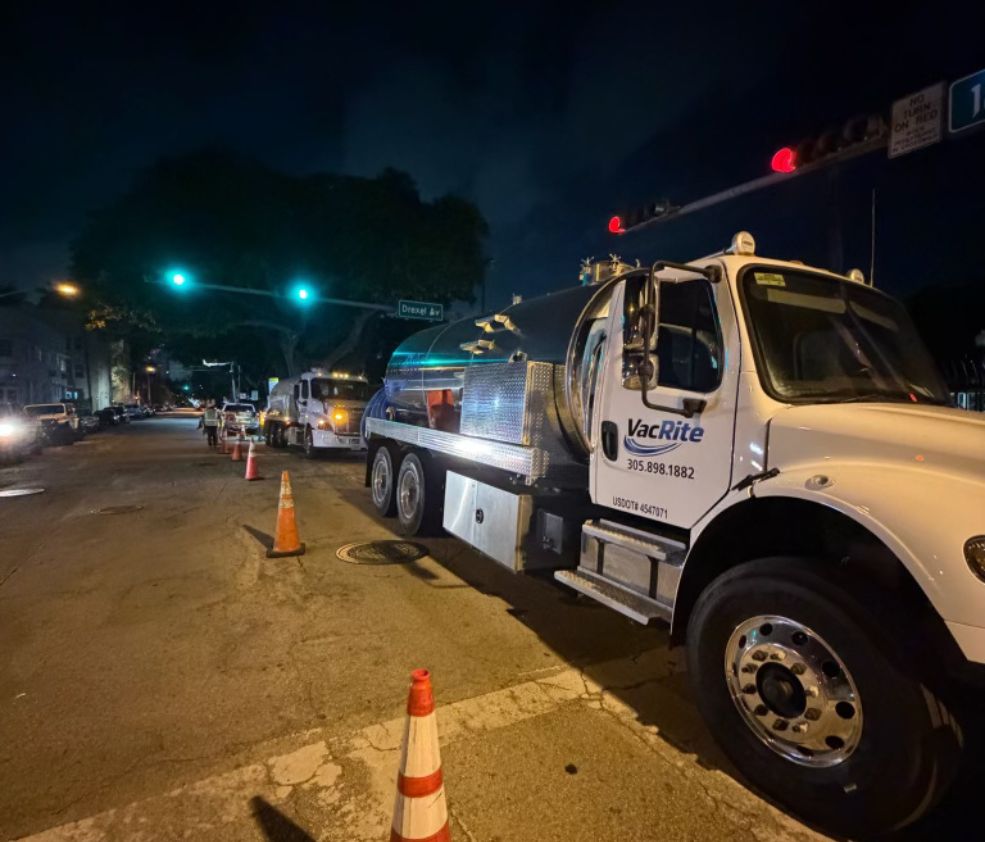
We run under sink grease trap service across South Florida, including Miami, Fort Lauderdale, West Palm Beach, and the rest of the region. See every city we cover or look at the trucks on the job.
Tell us what the job is
Tell us about the under sink grease trap service job. Where it is, what is around it, and when you need it.
Two trades, one call. We own the trucks, hold the permits, and put our own people on the job.
VacRite, Miami
info@vacriteservices.com
Open 24/7/365
USDOT 4547071