
Commercial Grease Trap Cleaning
Scheduled interceptor service for restaurants, supermarkets, hotels and multi-tenant kitchens, built around the hours you are closed.

Restaurant groups, supermarket chains, hotels, food halls, stadium and venue kitchens, and property managers with multiple tenant kitchens on one interceptor.
How a job runs, step by step
Survey the site
Trap size, location, access, and who is upstream of it. On a multi-tenant interceptor that last question matters a great deal.
Set a schedule that fits service hours
Overnight and early morning are normal. The kitchen should not lose a shift to a service call.
Run the full service
Complete pump-out, scraping, line cleaning where needed, inspection, approved disposal.
File the paperwork
Manifests and photos per location, so a multi-site operator has one consistent record set instead of a folder per vendor.
Multi-tenant interceptors and who is actually filling them
A shared interceptor under a shopping center or a food hall gets filled by whichever tenants cook the heaviest, and the service interval gets set by them rather than by the average. A pizza place with two fryers and a wok line will load a common interceptor several times faster than the sandwich shop three doors down, and the interceptor does not care whose lease says what. Property managers who track which tenants drive the loading can have a sensible conversation with them, backed by service records and photos rather than a hunch. Without that record, everybody pays the same share of a bill somebody else earned, and the tenants who cook light are the ones who complain loudest, because they are the ones who are right.
Supermarkets are their own animal
A supermarket is several food operations sharing a building. Deli, bakery, hot food, seafood and rotisserie all contribute, often through drains installed at different times, and the interceptor sizing frequently reflects the store as it was built rather than the store as it operates today. Add a rotisserie program to a store designed before rotisserie was a department and the loading changes without anybody revisiting the schedule. Seafood adds solids that settle rather than float, which is a different problem from grease and gets missed by anyone servicing from the top down. Those sites reward paying attention, and they punish a vendor who runs every store on the same calendar because the chain has one.
The 25 percent threshold on a commercial interceptor
The working rule is the same at every scale: service when fats, oils and grease reach a quarter of the trap’s capacity, or every three months, whichever lands first. What changes on a commercial site is how fast a quarter arrives. A trap past that point has lost the quiet volume it needs to let grease float and solids settle, so wastewater starts moving through faster than separation can happen and FOG rides out into the lateral. That is where the blocked line and the backed-up dish pit come from. On a busy interceptor, quarterly can be twice as long as the trap can hold, which is why we would rather set the interval from two or three real services than from a number on a page.
A complete service, not a skim
Complete means the grease cap, the wastewater and the bottom solids all leave the structure, then somebody scrapes the walls and the baffles, then somebody looks at the hardware. Baffles, inlet and outlet tees and the flow restrictor are what make a trap separate at all, and a missing or broken baffle turns an interceptor into a holding tank that passes everything through. Cracked walls and a settling structure show up the same way. On an indoor unit under a three-compartment sink the whole job takes minutes and still gets done properly. On a large in-ground interceptor out behind the loading dock it is a longer visit with a confined-space mindset, but the definition of finished does not change.
Scheduling around service, not around us
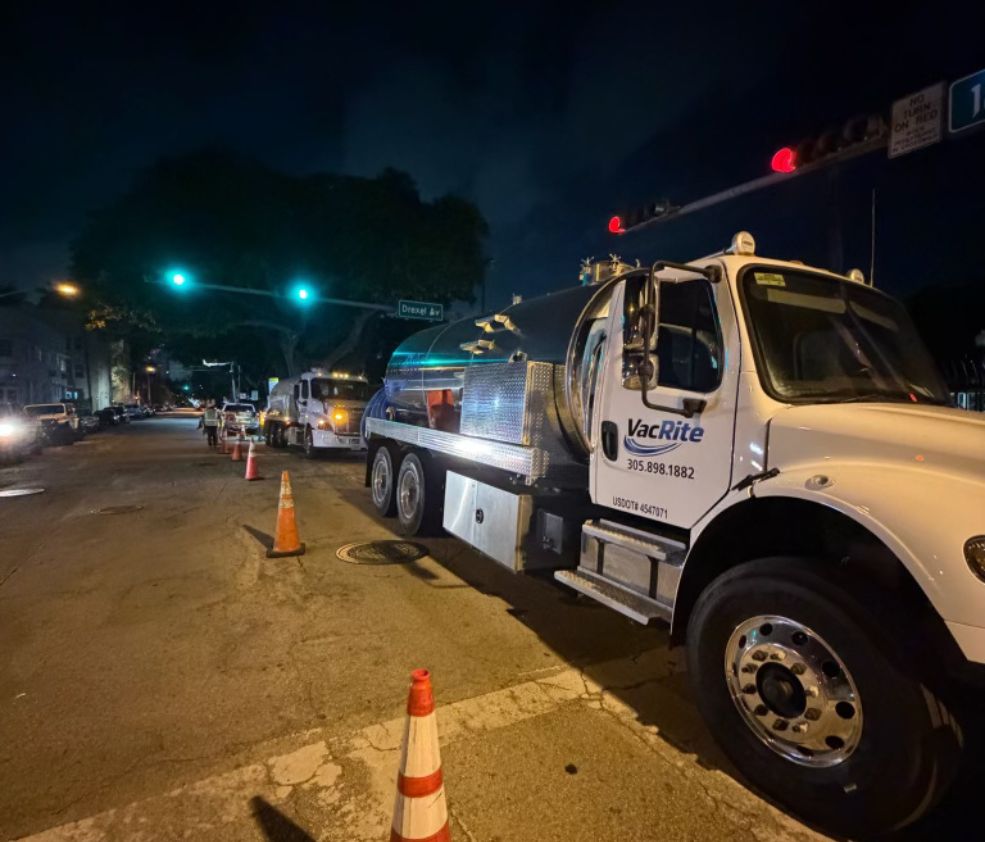
Kitchens are open when this work is inconvenient and closed when it is not. Running around the clock means the service can happen in the window that suits the operation, which is the difference between a maintenance program that holds and one that keeps getting pushed. Overnight on a restaurant row, pre-opening at a supermarket, between events at a hotel. We would rather move our night than move your service, and once the window is set for a location it tends to stay set, which is how the interval actually holds over a year.
Worth knowing
If you run several locations, ask for the records in one consistent format from the start. Reconstructing a year of service history across multiple vendors before an inspection is nobody’s idea of a good week.
Ask any contractor where what they pump out actually goes. It is a fair question, and the answer tells you a lot.
VacRite
Other grease work
The other side of the company
Most of our customers only ever need one half of what we do. It is worth knowing the other half exists.
Something failed tonight. Somebody answers.
Struck line, blocked kitchen drain, a basin backing up in the middle of a storm. We run every day of the year, and the phone reaches a person rather than a queue. This company is first responder owned, and the emergency side of it works the way that suggests.
Questions we get asked
Can you service several of our locations on one schedule?
Yes, and that is generally the easier way to run it. One schedule, one record format, one point of contact.
Will you work overnight so we do not lose service hours?
Yes. Overnight and pre-opening service is normal for us.
Who is responsible on a shared interceptor?
It depends on the lease, and we work with whoever holds it. We can document loading so property managers have something factual to work from.
Do you handle large in-ground interceptors?
Yes, along with smaller indoor units. Tell us the size and location.
What documentation do multi-site operators get?
Manifests, disposal records and photos per location, in a consistent format across the portfolio.
How do I know our interceptor is being fully pumped and not skimmed?
Before and after photos from inside the structure, every visit. A skim looks fine from the lid and leaves the bottom solids sitting there. The other tell is the interval: if a trap keeps needing service sooner than it used to, somebody has been taking the easy half.
Our supermarket has several departments on one interceptor. Does that change anything?
It changes the loading and often the interval. Deli, bakery, hot food, rotisserie and seafood all feed the same structure, and stores that added departments after they were built are frequently on a schedule that matches the original floor plan rather than today’s operation. We would rather watch it for a couple of services and set the interval from what the trap actually does.
We run commercial grease trap cleaning across South Florida, including Miami, Fort Lauderdale, West Palm Beach, and the rest of the region. See every city we cover or look at the trucks on the job.
Tell us what the job is
Tell us about the commercial grease trap cleaning job. Where it is, what is around it, and when you need it.
Two trades, one call. We own the trucks, hold the permits, and put our own people on the job.
VacRite, Miami
info@vacriteservices.com
Open 24/7/365
USDOT 4547071