
Line Jetting
High pressure water that scours grease and buildup off the inside wall of a drain line, rather than punching a hole through it.

Restaurants with slow or blocked kitchen lines, property managers with recurring backups, and anyone whose line keeps closing back up after being snaked.
How a job runs, step by step
Find the access
Cleanout location and line size decide the approach.
Run the jetter
A hose with a directional nozzle is fed up the line, and the backward-facing jets pull it forward while scouring the pipe wall.
Cut the buildup back to pipe
Grease, soap and sludge come off the wall rather than being bored through.
Flush and verify
Debris is flushed back to the access point and removed, and flow is confirmed.
Why jetting beats snaking on a grease line
A cable auger bores a hole through the blockage. Flow returns and everyone declares victory, but the pipe wall is still coated and the opening closes back up, usually sooner than last time. Picture a four inch line with an inch of hardened grease around the whole inside. A cable punches a two inch channel through it and water moves again, but you still have a four inch pipe doing the work of a two inch one, and the coating is still there collecting everything that goes past. Jetting scours the wall back toward bare pipe, so the interval resets properly. The tell that you have been snaking a grease problem is a line that needs clearing more often each time: six months, then four, then every few weeks, until it stops being a maintenance item and becomes the reason you closed early on a Friday.
Jetting and the trap are the same problem
A kitchen line that keeps blocking with grease and a trap that is not being serviced properly are usually the same story. Clearing the line without fixing the trap interval means doing it again. Because we handle both, it is a single conversation rather than two vendors each solving half. The physics is not complicated. A trap past a quarter full has lost the still volume it needs for grease to float and solids to settle, so FOG rides out through the outlet into the lateral, where the water cools and it sticks to the pipe wall. Every service after that adds another layer. Jetting takes the layers off, but if nothing upstream changes they start building back the next day.
Matching the pressure and the nozzle to the pipe
Jetting is not one setting. Pressure, flow volume and nozzle choice all get picked for the line in front of us. A hardened grease line wants a different nozzle from a sand-loaded storm lateral, and a rotating head that cuts well through heavy buildup is the wrong tool in old, thin-walled or already damaged pipe. Cast iron that has been in the ground since the sixties gets a gentler approach than modern PVC. Volume matters as much as pressure, because it is flow that carries the material you have cut loose back to the access point instead of leaving it to pack up again twenty feet further down. This is the part that separates jetting from just aiming water at a problem.
When repeat blockages mean the pipe itself
Buildup blocks a line gradually and it blocks it anywhere. A pipe defect blocks it repeatedly, and it blocks it in the same place every time. A belly, a section that has sagged so water and solids sit in it instead of moving on, will catch material endlessly no matter how well it is cleaned. So will an offset joint, a cracked section, or intruding roots. In this part of the state settlement in soft fill is common enough that bellies are a routine finding rather than an exotic one. If we clear the same spot on the same line three times, we will say so plainly, because at that point you are paying maintenance rates for what is actually a repair, and you deserve to know which one you are buying.
Storm lines and floor drains, not only kitchens
The same truck and the same hose clear more than restaurant laterals. Storm lines between catch basins silt up with sand and landscape debris and then quietly stop carrying what the basins collect, which is why a property can have clean basins and still hold water. Floor drains and trench drains in kitchens, garages and wash bays load with sediment and grease together. Because there is a vacuum truck on the same job, what gets cut loose comes out and leaves with us under permit rather than being flushed downstream to become somebody else’s blockage next month.
Worth knowing
If a line has blocked repeatedly at the same point, that can indicate a break, a belly or an offset joint rather than simple buildup. Repeat blockages in one spot are worth investigating properly.
Ask any contractor where what they pump out actually goes. It is a fair question, and the answer tells you a lot.
VacRite
Other drainage work
The other side of the company
Most of our customers only ever need one half of what we do. It is worth knowing the other half exists.
Something failed tonight. Somebody answers.
Struck line, blocked kitchen drain, a basin backing up in the middle of a storm. We run every day of the year, and the phone reaches a person rather than a queue. This company is first responder owned, and the emergency side of it works the way that suggests.
Questions we get asked
What is the difference between jetting and snaking?
A snake bores a hole through a blockage. Jetting scours the buildup off the pipe wall. On grease lines the difference shows up in how long the fix lasts.
Will jetting damage my pipes?
Pressure and nozzle get matched to the line and its condition. Older or already damaged pipe gets a different approach, which is part of why the line gets assessed first.
How often do kitchen lines need jetting?
It depends on volume and on whether the trap is being serviced properly. Lines that need it constantly usually point at a trap interval problem.
Can you jet and service the grease trap in one visit?
Yes, and it is the sensible way to do it since the two problems are related.
Do you handle emergency blockages?
Yes. A blocked kitchen line closes a kitchen, and we run around the clock.
The same spot keeps blocking. What does that mean?
Buildup blocks a line gradually and more or less anywhere. A defect blocks it in the same place every time. Repeat blockages at one point usually point to a belly where the pipe has sagged, an offset joint, a crack or roots. We will tell you when that is what we are seeing, because clearing it repeatedly is paying maintenance rates for a repair.
Can you jet storm lines and floor drains as well?
Yes. Storm laterals between catch basins silt up with sand and landscape debris, and trench and floor drains load with sediment and grease together. Because a vacuum truck is on the same job, the material comes out and leaves under permit rather than being pushed downstream to block somewhere else.
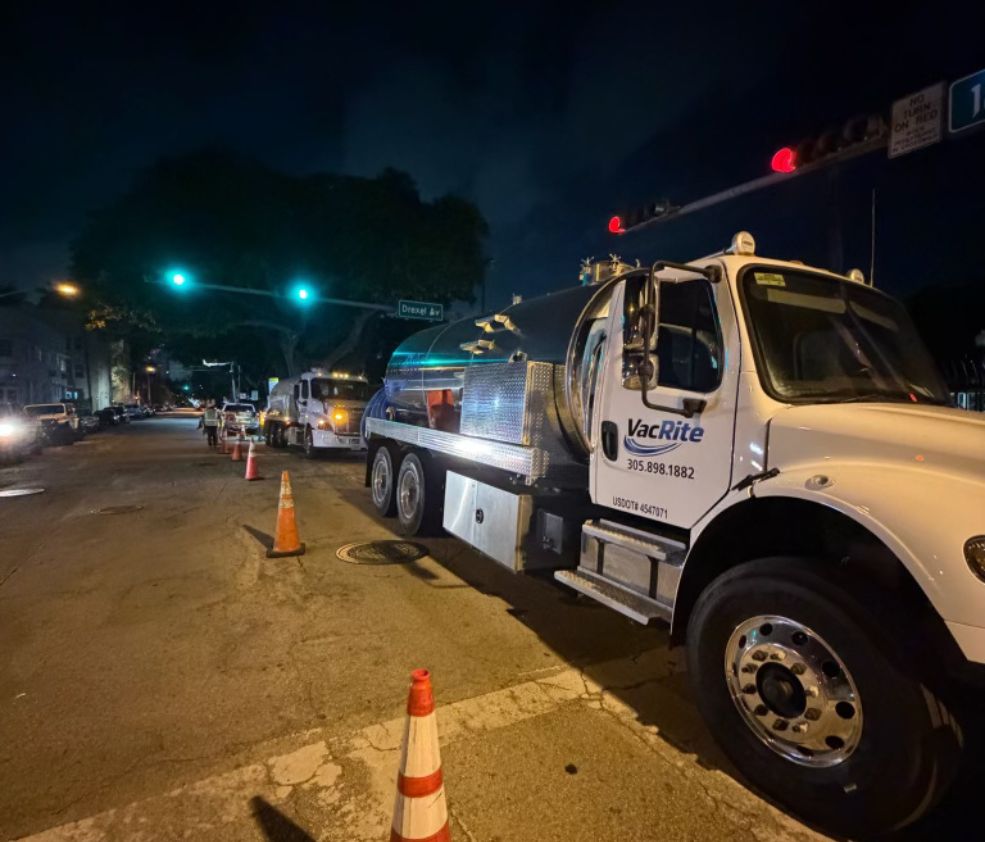
We run line jetting across South Florida, including Miami, Fort Lauderdale, West Palm Beach, and the rest of the region. See every city we cover or look at the trucks on the job.
Tell us what the job is
Tell us about the line jetting job. Where it is, what is around it, and when you need it.
Two trades, one call. We own the trucks, hold the permits, and put our own people on the job.
VacRite, Miami
info@vacriteservices.com
Open 24/7/365
USDOT 4547071