
Residential Services
What we can genuinely do at a house, and an honest answer about what most homes actually need.

Homeowners with a drainage or septic-adjacent problem on private property, property managers of small residential buildings, and anyone who has been told they have a grease trap at a house and is trying to work out what that means. If you are looking for routine household plumbing, a residential plumber is the better call.
How a job runs, step by step
Tell us what the actual problem is
A slow drain, a smell, standing water in a yard and a letter about a trap are four different jobs. Describe the symptom, not the solution you think you need.
We say honestly whether this is our work
Some of what homeowners call about is ours. A fair amount of it is not, and it is faster for both of us to say so.
If it is ours, we bring the right truck
Vacuum and hydro equipment, operated by our own crew under our own permits.
Dispose under permit and leave a record
Waste goes to a permitted facility and you get the paperwork, same as a commercial account.
Most homes do not have a grease trap
Worth saying first, because it saves people a lot of worry. Grease interceptors are a commercial requirement. They are written into FOG programs for food service establishments, and a normal single family home is not one. If you cook at home, the kitchen sink drains to your sewer lateral or to your septic system with no trap in between, and that is by design. So if you have arrived here after a slow kitchen drain and a search that mentioned grease traps, the odds are strong that you do not have one, and what you have is a clogged line, a problem in the lateral, or a septic system that needs attention. Those are different jobs with different fixes. The exceptions are real but narrow: a converted or accessory kitchen, a home that operates as a licensed food business, an in-law or guest unit with a second full kitchen, or a property that used to be commercial and kept the plumbing. If any of those describe you, there may genuinely be a trap on the property. If none of them do, be a little skeptical of anyone telling you your house needs a grease trap cleaned.
What we will actually do at a residential property
We are a commercial and municipal outfit. That is what the trucks, the permits and the crew are built for, and we would rather be straight about it than take a job we are not the best answer for. Inside that, there is real residential work we do well. Septic-adjacent and drain line work: pumping, clearing a blocked line, hydro-jetting a lateral that has scaled or rooted. Catch basins and drainage structures on private property, which is more common than people expect on larger lots, on private roads and in gated communities where the drainage is the owner’s problem rather than the city’s. Standing water that will not clear, or a yard drain that has silted in. And where a property genuinely does have a trap, on a converted kitchen or an accessory unit, we will service it properly and document it exactly the way we would for a restaurant. What we are not is a general residential plumber. If the job is a fixture, a water heater, a leak inside the wall or a repipe, we are not the right call, and a good local plumber will get you sorted faster.
HOAs, private communities and shared drainage
The place residential work overlaps most with what we do all day is community drainage. In a lot of South Florida communities the storm structures inside the gates belong to the association rather than to the city, which means catch basins, inlets and the lines between them are maintained privately or not at all. Not at all is the common one, right up until a heavy season and a parking area that holds water for two days. If you are on a board or managing a property and nobody is sure who cleans the basins, that is worth resolving before hurricane season rather than during it. This is ordinary work for us: vacuum out the structures, jet the connecting lines, and tell you plainly which ones are silted, which are damaged and which are fine. Same for a small residential building with a shared lateral that keeps backing up. It is closer to our commercial work than to a house call, and it is usually the residential-side call where we are genuinely the right people to phone.
Worth knowing
If someone has told you your house needs a grease trap serviced, ask them to show you where it is and what it is connected to before you agree to anything. A standard single family home does not have one, and it is a claim worth checking.

Ask any contractor where what they pump out actually goes. It is a fair question, and the answer tells you a lot.
VacRite
Other grease trap work
The other side of the company
Most of our customers only ever need one half of what we do. It is worth knowing the other half exists.
Something failed tonight. Somebody answers.
Struck line, blocked kitchen drain, a basin backing up in the middle of a storm. We run every day of the year, and the phone reaches a person rather than a queue. This company is first responder owned, and the emergency side of it works the way that suggests.
Questions we get asked
Does my house have a grease trap?
Almost certainly not. Grease interceptors are a commercial requirement for food service establishments. The exceptions are a converted or accessory kitchen, a permitted home food business, or a property that used to be commercial and kept the plumbing.
My kitchen drain is slow. Is that a grease problem?
It can be a grease buildup in the line, but it is a line problem rather than a trap problem, and it might also be a lateral issue or a septic issue. Describe what the drain is doing when you call and we will tell you whether it is our work.
Do you do residential work at all?
Some. Septic-adjacent and drain line work, hydro-jetting a blocked lateral, and catch basins and drainage structures on private property. We are set up for commercial and municipal work, so we will tell you honestly if you would be better served by a residential plumber.
Are you a plumbing company?
There is a master plumber on staff, but the business is vacuum and hydro work: grease interceptors, drainage structures, line clearing and excavation. Fixtures, water heaters and in-wall leaks are somebody else’s job and we will say so.
Our HOA has catch basins that hold water. Can you help?
Yes, and that is one of the residential-side jobs where we are genuinely the right call. Private community drainage is normal work for us. We vacuum the structures, jet the lines and tell you which ones are silted or damaged.
How do I find out if this is something you handle?
Call 305-761-4311 and describe the symptom. If it is our work we will get a truck out. If it is not, you will get a straight answer instead of a visit.
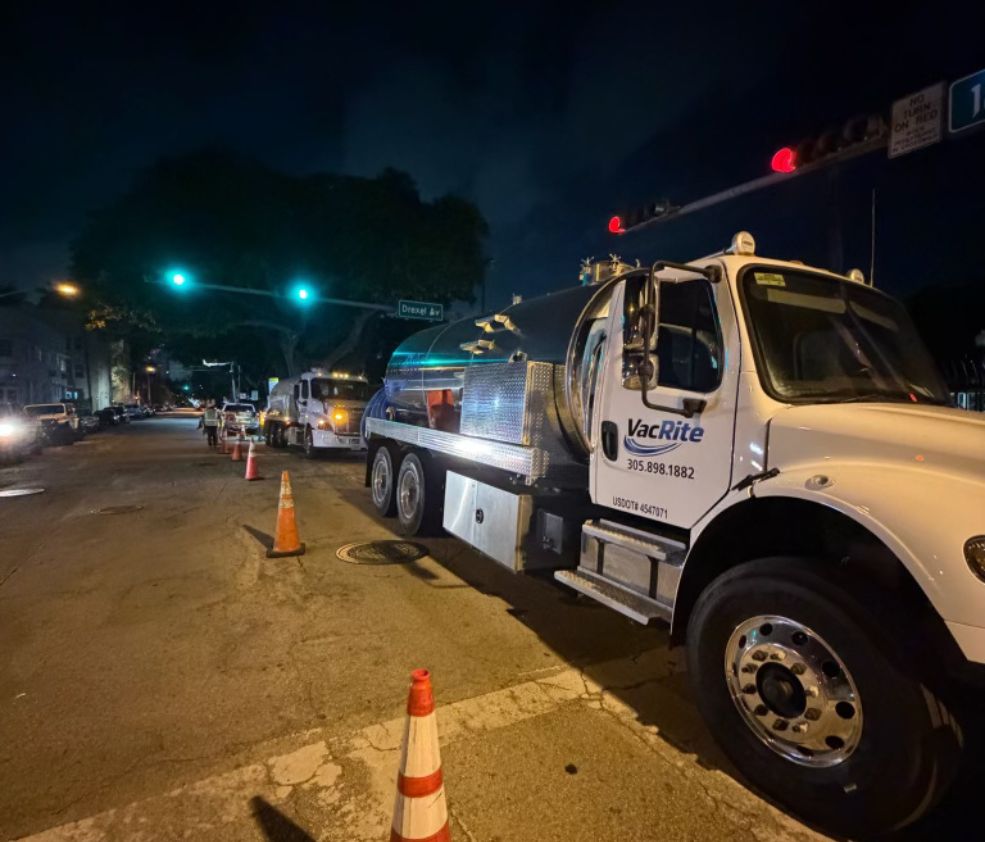
We run residential services across South Florida, including Miami, Fort Lauderdale, West Palm Beach, and the rest of the region. See every city we cover or look at the trucks on the job.
Tell us what the job is
Tell us about the residential services job. Where it is, what is around it, and when you need it.
Two trades, one call. We own the trucks, hold the permits, and put our own people on the job.
VacRite, Miami
info@vacriteservices.com
Open 24/7/365
USDOT 4547071