
Grease Trap Maintenance Plans
A standing agreement that puts your trap on a fixed service interval with a named window, a set scope of work and a record set, so nobody at your location has to remember to call anybody.

Restaurant groups and single locations, hotels, supermarkets, hospitals, school districts, municipal facilities departments and property managers who would rather own a schedule than a series of emergencies.
How a job runs, step by step
Survey the site once, properly
Equipment type and capacity, lid and access, hose run, what drains into it, and who is upstream on a shared structure. Done once, it prevents years of surprises.
Set the interval from real readings
The first services establish how your trap actually loads. The interval comes off those numbers rather than off a default.
Fix the window
The visit gets a day and an hour that suits your operation, and it stays fixed. A window that keeps moving is how a program quietly dies.
Run the same scope every time
Complete pump-out, scraping, hardware inspection, approved disposal, documentation. The definition of a finished visit does not change from month to month.
Report and adjust
Depth readings and hardware findings go into a running file, and if the loading moves, the interval moves with it before you have a problem.
What a plan actually commits to, in specific terms
A maintenance plan is worth having only if it is specific, so here is what the commitment consists of. A named interval, in days, tied to your equipment and your load rather than to a generic quarterly. A named service window, a day and time of day that suits your operation, held from visit to visit so your staff know when we arrive. A fixed scope, meaning every visit is the complete job: everything out of the structure, walls and baffles scraped, hardware inspected while it is empty, waste hauled to an approved facility. A record set delivered every visit, which is the manifest, the disposal documentation, before and after photos and the measured depths. A reminder before the visit rather than an invoice after it. Priority response when something goes wrong between scheduled visits, which is the part customers on a plan value most and the part they think about least when they sign up. And a review, because a plan set in January against a kitchen that changed in June is not a plan any more. What is deliberately not in it is a promise that nothing will ever back up. Nobody can promise that. What a plan gives you is the much better position of knowing the trap was serviced, being able to prove it, and having somebody who already knows your site answering the phone.
The interval is yours, not the industry’s
The default that everybody quotes is quarterly, or at a quarter of capacity, whichever comes first. That is a ceiling, not a schedule. Real kitchens sit all over the map around it. A high-volume fryer operation can pass the threshold well inside ninety days, which means quarterly service leaves it out of compliance for weeks at a stretch while everybody believes it is covered. A low-volume kitchen with a generously sized structure may never come close, and quarterly service there is money spent on a truck visit that removed almost nothing. Both of those are failures of the same kind, which is a schedule chosen before anyone looked. So the interval on a plan comes from measurements. We sound the structure on arrival every visit and record grease depth, solids depth and liquid level, and after two or three services there is a loading rate rather than a guess. From there the arithmetic is simple: how many days does this trap take to reach its threshold, and set the visit comfortably inside that. It also means the plan can respond. A restaurant that adds a fryer program in the fall will show up in the numbers as a shortening interval, and the interval gets adjusted then, rather than after a line blocks.
Multi-site and multi-tenant, where a plan earns its keep
One location can be run off a calendar reminder and a phone. A portfolio cannot. Once there are eight locations, three equipment types, four different service windows and a compliance file per site, the coordination is the actual work and the pumping is the easy part. A plan across a portfolio means one schedule, one consistent record format and one point of contact, which is the difference between an inspection you answer in ten minutes and a week of emailing former vendors. On a shared interceptor under a shopping center or a food hall it does something else as well. The structure gets filled by whichever tenants cook heaviest and the interval gets set by them, which is a conversation between property manager and tenant that goes far better with documented loading and photos than with an opinion. For public agencies, a plan is often the only form the work can take, because a facilities department needs a defined scope, a defined interval and records that survive staff turnover. Our haulers permit, dumping permit, USDOT 4547071, bonded and insured status and master plumber on staff are the parts of that paperwork we can hand over on day one.
Why a standing plan holds when a reminder does not
The honest reason maintenance plans exist is that trap service is nobody’s job. It is not the chef’s, it is not the front of house manager’s, and in a kitchen with turnover the person who used to call us left in March. So the trap gets serviced when it becomes a problem, which means it is serviced late by definition, and late is where the real costs live: the emergency call at the worst hour, the blocked lateral that now needs jetting, the shift lost to a backed-up dish pit, the notice of violation. A standing plan moves the remembering off your staff. The visit is on our schedule, we call ahead, and the file builds itself in the background. It also means the same crew keeps coming back, which sounds like a small thing and is not. A crew that already knows where your lids are, which one is under the delivery path, that the second chamber runs heavy and that the outlet tee was replaced in spring is faster and catches more than a stranger does. Call 305-761-4311 and we will look at the site, set an interval from what your trap actually does, and put a truck on it on a window that does not cost you a shift.
Worth knowing
Be careful with a plan that does not say what a visit includes. If the scope is not written down, the cheapest possible interpretation of it is what shows up: the floating layer skimmed, the solids left, nothing scraped, no photos. Get the scope, the interval and the deliverables in writing.
Ask any contractor where what they pump out actually goes. It is a fair question, and the answer tells you a lot.
VacRite
Other compliance work
The other side of the company
Most of our customers only ever need one half of what we do. It is worth knowing the other half exists.
Something failed tonight. Somebody answers.
Struck line, blocked kitchen drain, a basin backing up in the middle of a storm. We run every day of the year, and the phone reaches a person rather than a queue. This company is first responder owned, and the emergency side of it works the way that suggests.
Questions we get asked
What is included in a maintenance plan?
A set interval, a fixed service window, a defined scope for every visit, complete pump-out with scraping and hardware inspection, approved disposal, a full record set each visit, reminders before service, priority response between visits, and a periodic review of the interval.
How do you decide our interval?
From measurements. We record grease depth, solids depth and liquid level on every arrival, and after two or three services we know your loading rate. The interval comes off that, not off a default quarterly.
Are we locked in?
The point of the plan is that the work happens without anybody chasing it, not that you are stuck. Tell us what your operation needs and we will tell you plainly whether a standing plan makes sense for it.
Can you cover several locations under one plan?
Yes, and that is usually the easier way. One schedule, one record format, one point of contact, even when the sites have different equipment and different windows.
What happens if we back up between scheduled visits?
You call 305-761-4311 and we come. Plan customers get priority response, and we run 24/7/365, so a two in the morning problem is a normal call rather than a message somebody returns Monday.
Will you work around our service hours?
Yes, and the window becomes part of the plan. Overnight, pre-opening or between events, whatever fits, held consistently so your staff know when to expect us.
We already have a vendor. Is switching disruptive?
Not particularly. What matters is the handoff of records, since we can document everything we do and nothing anybody else did. Get whatever file exists from your current vendor before you move, and we will start a clean one from the first visit.
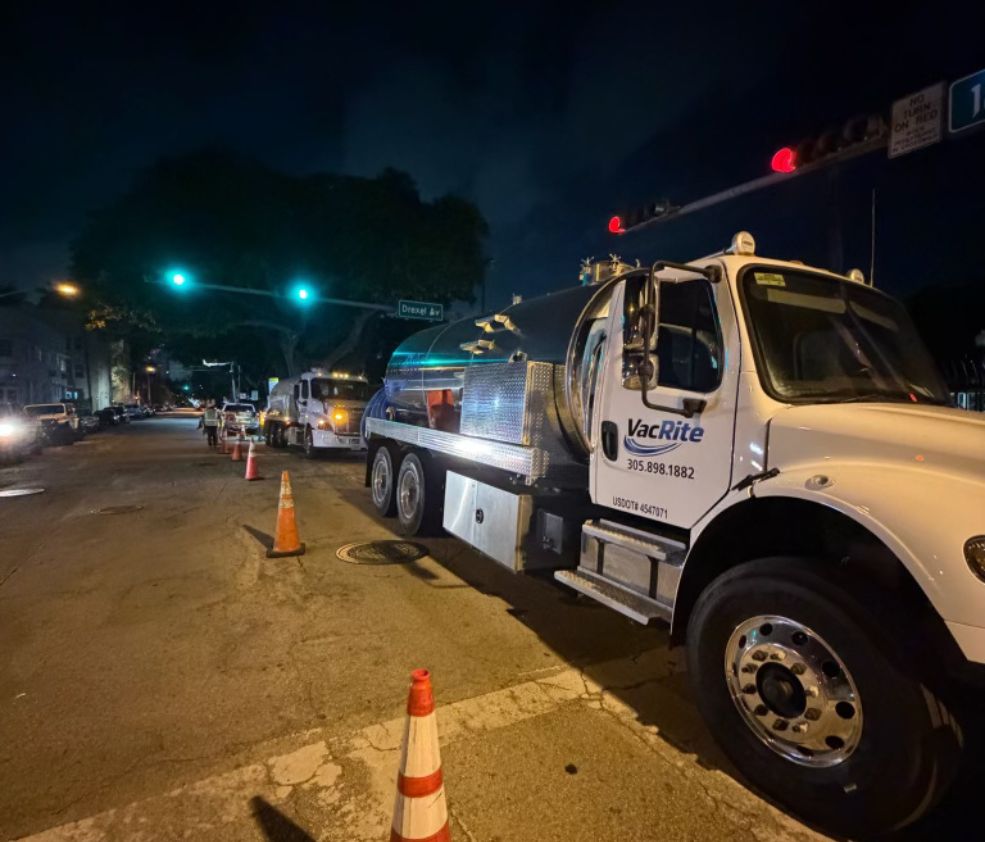
We run grease trap maintenance plans across South Florida, including Miami, Fort Lauderdale, West Palm Beach, and the rest of the region. See every city we cover or look at the trucks on the job.
Tell us what the job is
Tell us about the grease trap maintenance plans job. Where it is, what is around it, and when you need it.
Two trades, one call. We own the trucks, hold the permits, and put our own people on the job.
VacRite, Miami
info@vacriteservices.com
Open 24/7/365
USDOT 4547071