
Grease Trap Cleaning
Full pump-out, scraping and inspection of grease traps and interceptors, with the paperwork inspectors ask for.

Restaurants, hotels, supermarkets, schools, hospitals, cafeterias and any kitchen with a trap on the drain line.
How a job runs, step by step
Pump it out completely
Grease, solids and wastewater all come out. A partial pump-out that leaves the bottom solids behind is the most common way this service gets done badly.
Scrape the walls and baffles
Hardened grease clings to trap walls and baffles and does not leave on its own. Scraping is what makes the next interval hold.
Hydro-clean the lines when they need it
Inlet and outlet lines get cleared where buildup has started to restrict flow.
Inspect the hardware
Baffles, flow restrictor, inlet and outlet tees, lid and structure. Cracks and missing baffles get reported before they become a failure.
Dispose and document
Waste goes to an approved facility, and you get a manifest, before and after photos and disposal records.
The 25 percent rule, in plain terms
The working standard is that a trap gets cleaned when fats, oils and grease reach a quarter of the trap’s capacity, or every three months, whichever arrives first. The reason is not paperwork. Past about a quarter full, a trap stops separating properly and starts passing grease into the sewer line, which is the thing it was installed to prevent. A trap does not filter anything. It is a box that slows water down. Wastewater comes in hot with grease suspended in it, and the box holds it long enough for the water to cool, for the grease to float to the top and for the food solids to sink to the bottom. Clean water in the middle band leaves through the outlet. That whole mechanism depends on volume and on time. Fill a quarter of the box with grease on top and solids underneath and you have taken away the still middle the separation needs, so water moves through faster, has less time to cool, and carries the grease straight past the outlet tee into your lateral. The trap looks like it is working right up until the day the line backs up.
Complete pump-out, and what skimming leaves behind
There are two ways to service a trap and only one of them counts. The wrong way is to pull the floating grease cap off the top, look at clear water, and call it done. It is quick, it looks convincing with the lid off, and it leaves the entire bottom layer of settled food solids exactly where it was. Those solids are what rot, what makes the smell, and what fills the trap back to the threshold in a fraction of the time. A complete service takes everything: the grease cap, the water column and the solids off the floor, down to an empty structure. Then the walls and baffles get scraped, because hardened grease clings to concrete and steel and does not come out with the liquid. Every layer left on a wall is a head start on the next accumulation. Scraping is the difference between an interval that holds and an interval that keeps shrinking.
Tees, baffles and the parts that quietly fail
While the trap is empty and lit is the only time anybody can see what is actually in it, so that is when it gets looked at. The inlet tee should carry incoming flow down below the surface so it does not plow through the floating grease layer and push it toward the outlet. The outlet tee should draw from the clean middle band rather than the top or the floor. Baffles divide the chambers and hold the flow pattern that makes separation work. A flow restrictor upstream keeps the trap from being hit with more water than it can hold long enough to do anything with. Any one of those missing, broken or corroded away turns the trap into a holding tank that passes grease straight through, and none of it is visible from the top with the trap full. We also look at the structure itself: cracked walls, a spalling lid, a corroded frame, and in this part of the state, groundwater finding its way in through a failed joint. You hear about all of it that visit, with photos, while it is still a repair rather than a failure.
Setting an interval from your kitchen, not from a default
A quarterly default is a starting point, not an answer. A high-volume fryer kitchen can hit the threshold well inside three months. A low-volume operation with a large trap may not come close. We would rather watch what your trap actually does over a couple of services and set the interval from that, so you are neither out of compliance nor paying for cleanings you did not need. What we are reading is the loading: how deep the grease cap is when we open it, how much solid is on the floor, how those numbers move between visits. A wok line and a breakfast griddle load a trap differently. So does a supermarket deli, a hotel banquet kitchen running events unevenly through the year, a school cafeteria that goes quiet all summer. Season matters here too, since a lot of South Florida operations run heavy through the winter and light through August. An interval built on your own numbers holds up in front of an inspector far better than a schedule somebody picked off a form.
What a bad cleaning looks like, and what the manifest is for
Skim the floating layer, leave the solids on the bottom, no scraping, no paperwork. The trap looks serviced and fails early. The tells are simple: the interval keeps getting shorter, odors come back within days, and there is no manifest in the file when an inspector asks. That last one is the one that bites. Grease is a regulated waste, and pumping it out is only the first half of the obligation. It has to go to a facility permitted to receive it, and there has to be a document saying so with a date, a volume and a destination on it. That is the manifest, and it is what turns an inspection into a five minute conversation. Ours comes with before and after photos and disposal records every service, under our own haulers and dumping permits. Keep them in one folder rather than in a drawer of loose receipts. The inspection that goes badly is almost never the one where the trap was dirty. It is the one where nobody could find last quarter’s paperwork.
Worth knowing
Keep your service records where you can find them. When an inspector asks, the records are the difference between a routine visit and a problem.
Ask any contractor where what they pump out actually goes. It is a fair question, and the answer tells you a lot.
VacRite
Other grease work
The other side of the company
Most of our customers only ever need one half of what we do. It is worth knowing the other half exists.
Something failed tonight. Somebody answers.
Struck line, blocked kitchen drain, a basin backing up in the middle of a storm. We run every day of the year, and the phone reaches a person rather than a queue. This company is first responder owned, and the emergency side of it works the way that suggests.
Questions we get asked
How often does a grease trap need cleaning?
When fats, oils and grease reach about 25 percent of capacity, or every three months, whichever comes first. Real kitchens vary a lot, so we help set an interval based on what your trap actually does.
What is included in a cleaning?
Complete removal of grease, solids and wastewater, scraping of walls and baffles, hydro-cleaning of inlet and outlet lines when needed, inspection for damage, proper disposal, and documentation with photos.
Do you provide a manifest?
Yes, every service, along with before and after photos and disposal records. That is the file inspectors ask for.
Can you service us outside business hours?
Yes. Most kitchens prefer overnight or early morning, and we run around the clock.
What if the trap turns out to be damaged?
You hear about it that visit, with photos. Cracked walls, failed baffles and missing tees all stop a trap from working, and it is better to know early.
Do you handle both indoor and outdoor traps?
Yes, from small under-sink units through to large in-ground interceptors.
Why does our trap fill back up so fast after a service?
Usually because the last service only took the floating layer. Skimming the grease cap leaves the settled solids on the floor and leaves hardened grease on the walls and baffles, so the trap starts the next cycle already partly loaded. A shrinking interval is the clearest sign of it. The other possibility is hardware: a missing baffle, a broken inlet or outlet tee, or no flow restrictor, any of which stops the trap separating no matter how well it is pumped.
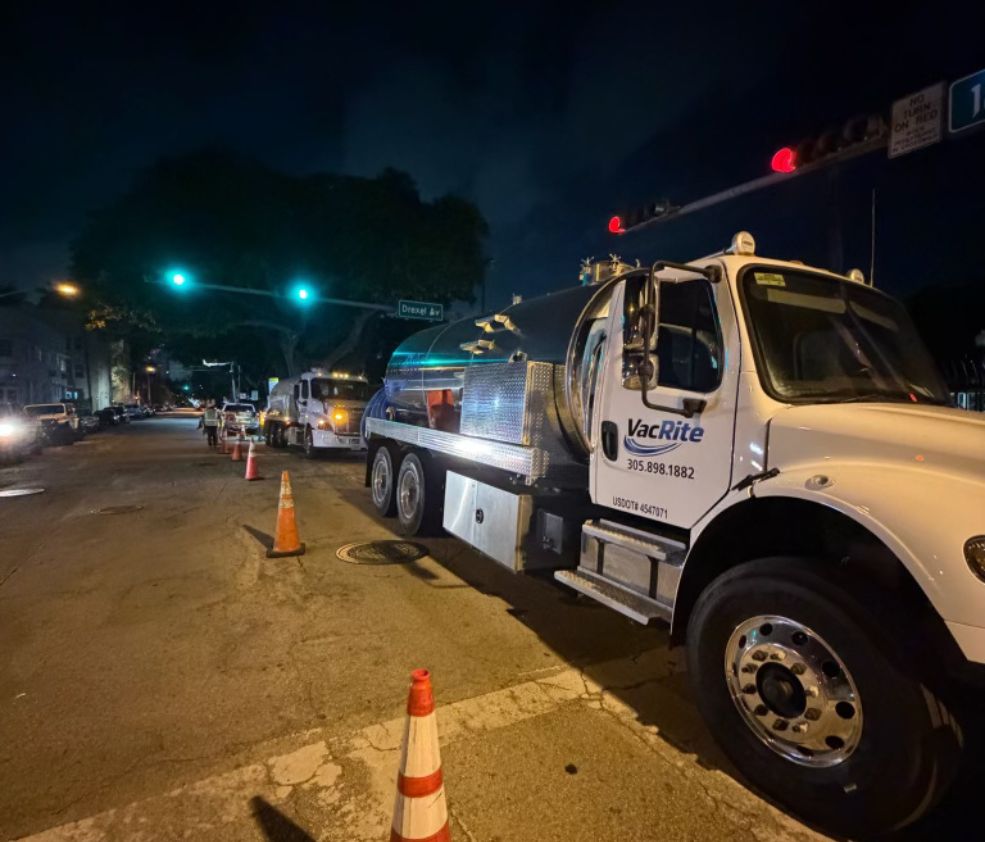
We run grease trap cleaning across South Florida, including Miami, Fort Lauderdale, West Palm Beach, and the rest of the region. See every city we cover or look at the trucks on the job.
Tell us what the job is
Tell us about the grease trap cleaning job. Where it is, what is around it, and when you need it.
Two trades, one call. We own the trucks, hold the permits, and put our own people on the job.
VacRite, Miami
info@vacriteservices.com
Open 24/7/365
USDOT 4547071