
Catch Basin Cleaning
Vacuuming out the sediment, debris and standing water that stop a storm drain from draining.

Property managers, retail and industrial sites, HOAs, municipalities and anyone whose parking lot holds water after a storm.
How a job runs, step by step
Open and assess
Grate off, look at what is actually in there. Sediment depth tells you a lot about how long it has been.
Vacuum it out
Water, sediment, silt and debris all come out into the tank.
Clear the connecting pipes
The sump is only half of it. If the outlet is restricted, an empty basin still will not drain.
Inspect the structure
Walls, inverts, grate and frame. Structural failure in a basin gets worse quietly and then all at once.
Haul and document
Material goes to an approved disposal site under permit.
Why South Florida basins fill faster than people expect
Sand, landscape debris, and a rainy season that arrives as intense afternoon storms rather than gentle rain. Sediment washes in fast and settles in the sump. Add a flat site with very little fall, a high water table under it, and the tidal influence coastal areas deal with, and a basin that is half full of sand simply stops keeping up. That shows up as standing water in a parking lot after every storm.
The cost of finding out during hurricane season
The wrong time to discover a blocked basin is during the first serious storm of the season. Water that cannot get into the drain goes wherever the grade sends it, which is usually toward a building. Cleaning basins before the season is ordinary maintenance. Dealing with what happens when they are full is not. The calendar here is not subtle: the work wants to happen in the spring, while the basins are dry, the crews are available and a truck can sit in a parking lot for an afternoon without anybody minding. Once the season is running, every property in three counties wants the same thing on the same week, and a basin full of sand does not care about your place in the queue.
What the sump is actually holding
Open a neglected basin on a South Florida commercial site and the profile is usually the same. Sand and fine silt at the bottom, a layer of landscape debris and mulch above it, cigarette butts and parking lot trash floating on whatever water is standing, and often a slick of oil off the pavement. All of it comes out into the tank, water included, and it all rides to an approved disposal facility under our permits. What people underestimate is how heavy saturated sand gets and how far up the sump it has crept, because from the grate you are looking at water and can only guess what is under it. Sediment depth is the number that tells you how long it has been, and it is usually longer than the file says.
Flat ground, high water and the tide
Three things make drainage here different from almost anywhere else. Sites are flat, so there is very little fall to work with and a basin set an inch high may as well not be there. The water table sits close to the surface, so a lot of structures hold standing water permanently and never really dry out, which is why sediment compacts in the sump instead of washing through. And in coastal areas the storm system is tidally influenced, so a high tide during a heavy rain means the outfall end is already full and the system has nowhere to push. None of that is fixable by cleaning, but all of it means the margin is thin, and a basin half full of sand eats the margin you have left.
Look at the structure while it is open
A basin is a concrete or block box in wet ground, and it fails from the inside where nobody sees it. Walls spall and crack. The invert, the shaped channel at the bottom that carries flow to the outlet, wears down or fills in until water sits instead of moving. Frames work loose from the surrounding pavement and grates crack or go missing entirely, which is a liability problem long before it is a drainage one. Everything above is visible in the ten minutes the structure is empty and lit, and invisible the rest of the year. So we look, we photograph, and you get told. A wall that is starting to go is a planned repair. A wall that has gone is a hole in your parking lot.
Worth knowing
Standing water that lingers after a storm, water backing up around the grate, or a smell coming off the drain are all worth a look. They rarely resolve on their own.
Ask any contractor where what they pump out actually goes. It is a fair question, and the answer tells you a lot.
VacRite
Other drainage work
The other side of the company
Most of our customers only ever need one half of what we do. It is worth knowing the other half exists.
Something failed tonight. Somebody answers.
Struck line, blocked kitchen drain, a basin backing up in the middle of a storm. We run every day of the year, and the phone reaches a person rather than a queue. This company is first responder owned, and the emergency side of it works the way that suggests.
Questions we get asked
How often should catch basins be cleaned?
It depends on how much sediment your site sheds and how heavy your landscaping is. Once a year before the rainy season suits many properties; sandy or heavily landscaped sites need it more often.
How do I know if a basin needs cleaning?
Standing water after a storm, slow drainage, water pooling around the grate, or odor. If you can see sediment near the top of the sump, it is well overdue.
Do you clean the pipes as well as the basin?
The connecting lines get cleared where they are restricted. An empty basin with a blocked outlet still does not drain.
What happens to the material you remove?
It is hauled under our permits to an approved disposal facility and documented.
Can you handle a whole property in one visit?
Yes, and doing every basin on a site at once generally makes more sense than chasing them one at a time.
When is the best time of year to do this?
Before the rainy season, while the structures are dry and the schedule is open. Once storms are running, every property in the region wants the same service in the same week, and a basin already full of sand does not wait its turn politely.
Our lot still holds water after cleaning. What now?
That usually means the problem is downstream or structural rather than sediment in the sump. A restricted or collapsed outlet pipe, a worn invert that lets water sit, a frame set too high for the grade, or simply no basin where the low point actually is. Those are all things worth looking at properly, and all of them are work we do.
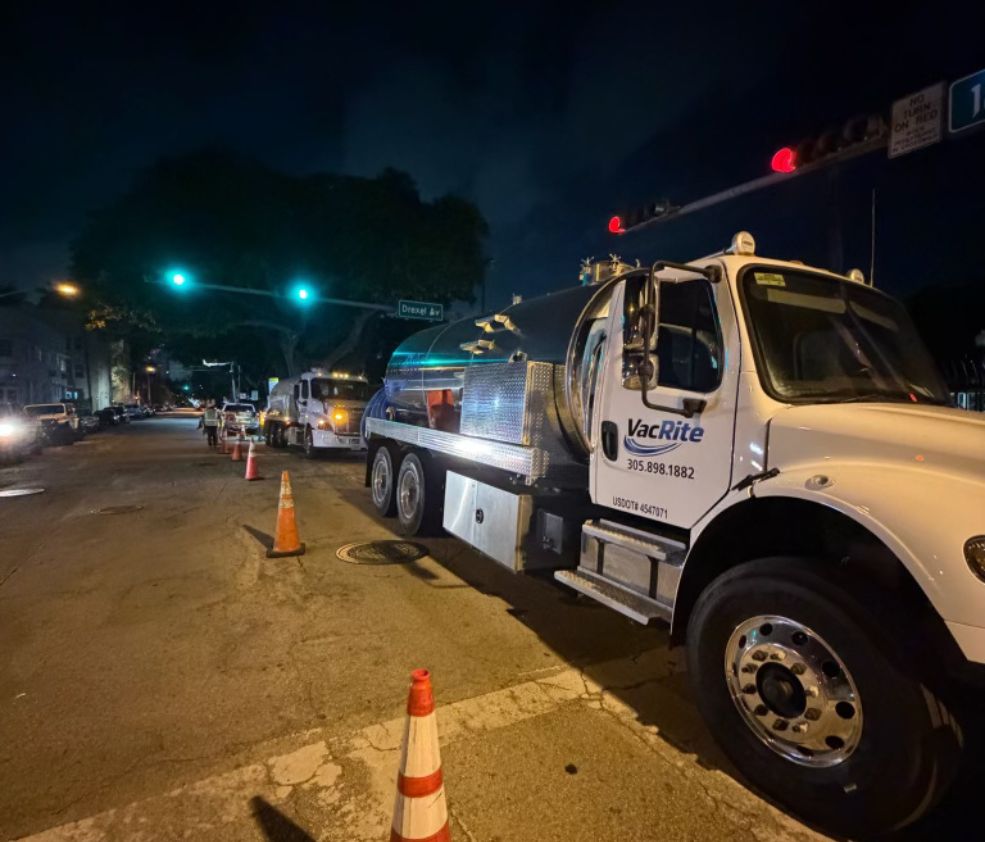
We run catch basin cleaning across South Florida, including Miami, Fort Lauderdale, West Palm Beach, and the rest of the region. See every city we cover or look at the trucks on the job.
Tell us what the job is
Tell us about the catch basin cleaning job. Where it is, what is around it, and when you need it.
Two trades, one call. We own the trucks, hold the permits, and put our own people on the job.
VacRite, Miami
info@vacriteservices.com
Open 24/7/365
USDOT 4547071