
Gravity Grease Interceptor
Service for the large in-ground concrete interceptors that separate grease by retention time, holding a kitchen’s wastewater long enough for physics to do the work.

Full service restaurants with exterior structures, hotels and resorts, hospitals, school districts, universities, correctional and municipal kitchens, casinos, stadiums, supermarkets, and shopping centers where several tenants share one in-ground unit.
How a job runs, step by step
Locate and open the structure
Find the lids, which on older sites is its own task, then open with the right lifting gear. Traffic-rated covers are heavy by design and get treated that way.
Sound the structure before pumping
Grease cap depth, solids depth and total liquid depth measured and recorded from the surface. On a gravity unit those depths against the structure’s rated volume are exactly what the 25 percent threshold is measured on.
Pump every chamber to the floor
Grease cap, water column and the settled solids, in each chamber. The last chamber gets the same attention as the first.
Scrape the walls, baffle walls and lid underside
Hardened grease on concrete does not release with the liquid. It gets scraped, then the structure gets rinsed and the rinse water pumped off.
Inspect the structure and its hardware
Inlet and outlet tees, baffle walls or crossover pipes, wall and joint condition, corrosion above the water line, frame, riser and lid. Photographed empty.
Refill, close and document
Structure closed properly and left in the condition it should be in, then the manifest, the disposal record and the photos.
Retention time is the entire mechanism
A gravity interceptor has no moving parts and nothing clever inside it. It works because it is big. Hot wastewater arrives carrying grease in suspension, and the structure’s only trick is to hold that water still and long enough that the water cools, the grease loses its ride and floats, and the food solids give up and sink. What is left in the middle band is water clean enough to send to the sewer, and the outlet tee draws from exactly that band. Everything about the design serves retention time. The volume is large so the water slows down. The inlet tee drives flow downward so incoming water does not shove the floating cap toward the outlet. The baffle wall or crossover forces water to travel the long way. The structure sits in the ground partly because that is where the space is and partly because the ground keeps it cool, and cooling is half the separation. This is why the 25 percent threshold exists in plain physical terms. Grease on top and solids on the bottom are both stealing retention volume, and once they have taken a quarter of the box the remaining middle is too small and too fast. The water gets through before it has cooled, still carrying grease, and the interceptor quietly becomes a very expensive length of pipe while looking, from the lid, exactly as it always has.
Sizing is retention volume, which is a different question from flow
A gravity unit is specified by how many gallons it holds. A compact hydromechanical unit is specified by how many gallons per minute it can process. Those are not the same question and the difference decides which equipment belongs on a site. Volume sizing on a gravity interceptor runs off drainage fixture units or off seats and meals served depending on the jurisdiction and the era of the install, and the number that comes out is a retention volume intended to give the structure enough still water to work with between services. The practical consequence is that a gravity interceptor is far more tolerant of a burst. A dish machine dumping its tank into a large in-ground structure barely registers, where the same burst into an undersized point-of-use unit blows straight through it. What a gravity unit is not tolerant of is being left too long, because its whole advantage is volume and accumulation is the thing that takes the volume away. That is also why the depth readings matter more here than a calendar does. A structure with an unusual grease-to-solids ratio, heavy solids and a thin cap, is telling you something about the kitchen, and a structure whose liquid level does not match what the kitchen sent is telling you about groundwater getting in through a bad joint.
Lids, depth and confined space, honestly
These structures are the heaviest and least convenient equipment in this trade to get into. A traffic-rated cast iron cover on a unit under a drive lane is a genuine lift and it is not something a kitchen manager should be prying up with a screwdriver on a Sunday. Depth varies, and a deep structure with a riser stack means a long hose run and a heavier pump. Access gets worse with time rather than better: overlays bury frames, landscaping grows over rings, corrals and equipment pads get built on top of lids, and on a site that has changed hands twice nobody still working there knows where the second lid is. That is what a survey visit is for, and it is why a first service on an unknown site takes longer than the steady state does. The confined space rule on these is simple and not negotiable. A below-grade interceptor is a permit-required confined space with an oxygen-deficient atmosphere and hydrogen sulfide in it, and it has killed people, routinely people who went in to help somebody who went in first. Our crews do not enter. The cleaning is designed so entry is unnecessary, worked entirely from the surface with hose and scraper, and the opening stays guarded the whole time it is off. If a structure ever genuinely requires entry for a repair, that is a separate scope with its own procedure and equipment, planned in advance, never improvised on a service call.
What a concrete structure in South Florida ground is up against
The interceptor is a concrete box buried in wet, warm, aggressive ground, and it ages. The sludge layer on the floor goes anaerobic and generates hydrogen sulfide, which does very little to the concrete under water and a great deal to the concrete above it, where it converts to acid on damp surfaces and eats the walls, the underside of the lid, the frame and any exposed steel. So the classic condition of an old interceptor here is sound below the water line and soft and spalling above it, with a frame you can flake apart by hand. Add a high water table and every failed joint becomes an infiltration point, which dilutes the contents, steals retention volume and shows up as liquid levels that do not add up. Root intrusion at the joints does the same thing from a different direction. None of this is visible with the structure full, which is why the inspection while it is empty and lit is a real part of the service rather than a formality. What you get from it is lead time. A structure with a known remaining life is a budget line and a planned replacement. The same structure discovered at the point of failure is a closed kitchen. Call 305-761-4311 and we will get a truck out, open it, and tell you what you actually have down there.
Worth knowing
Find out where every lid on your property is, and mark it, before you need it at eleven at night. Buried and paved-over interceptor lids are common on sites that have been resurfaced or changed hands, and the discovery always happens on the worst possible evening.
Ask any contractor where what they pump out actually goes. It is a fair question, and the answer tells you a lot.
VacRite
Other grease work
The other side of the company
Most of our customers only ever need one half of what we do. It is worth knowing the other half exists.
Something failed tonight. Somebody answers.
Struck line, blocked kitchen drain, a basin backing up in the middle of a storm. We run every day of the year, and the phone reaches a person rather than a queue. This company is first responder owned, and the emergency side of it works the way that suggests.
Questions we get asked
What makes an interceptor a gravity unit?
It separates by retention time and volume alone. No flow control device, no internal mechanism, just a large structure that holds wastewater still long enough for grease to float and solids to settle.
How is a gravity interceptor sized?
By retention volume in gallons, worked from drainage fixture units or from meals and seating depending on the jurisdiction. That is a different question from a flow-rated unit, which is sized by gallons per minute.
When does it need to be serviced?
When grease and solids together reach about a quarter of the structure’s capacity, or every three months, whichever lands first. Past that point there is not enough still volume left for separation to happen.
Do your crews go inside the structure?
No. It is a permit-required confined space with an atmosphere nobody should trust, and the cleaning does not need entry. It is worked from the surface, and the opening stays guarded while it is off.
Can you find our interceptor if nobody knows where it is?
Usually. Between the plumbing layout, the drain line run and what the surface tells us, buried lids get found. It is a common situation on sites that have been resurfaced or have changed owners, and it is easier on a survey visit than during an emergency.
Our liquid level is higher than it should be. What causes that?
Often groundwater infiltrating through a failed joint or a cracked wall, which is common in this part of the state where the water table is high. It dilutes the contents and eats the retention volume, so the structure separates worse while looking normal from the lid.
The concrete above the water line is crumbling. Is that normal?
It is common and it is not something to ignore. Hydrogen sulfide off the sludge layer attacks concrete and steel above the liquid, so old structures wear from the top of the water line up. We photograph it each visit so you can watch the progression and plan a replacement rather than react to a collapse.
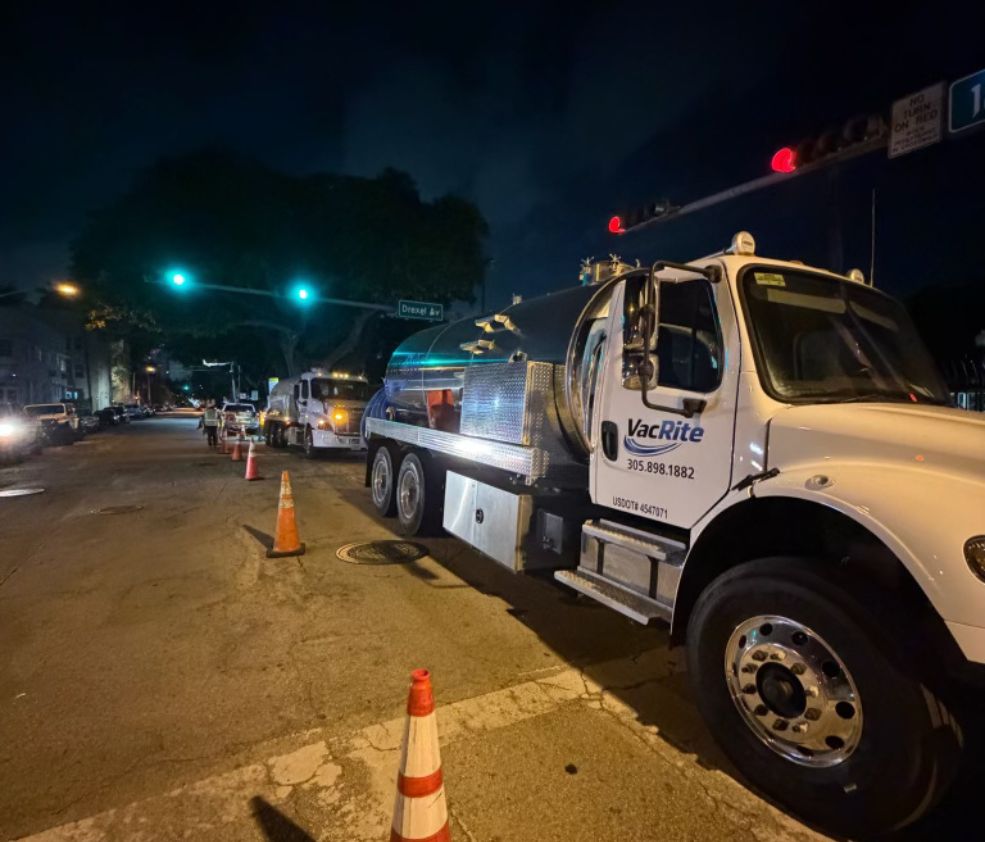
We run gravity grease interceptor across South Florida, including Miami, Fort Lauderdale, West Palm Beach, and the rest of the region. See every city we cover or look at the trucks on the job.
Tell us what the job is
Tell us about the gravity grease interceptor job. Where it is, what is around it, and when you need it.
Two trades, one call. We own the trucks, hold the permits, and put our own people on the job.
VacRite, Miami
info@vacriteservices.com
Open 24/7/365
USDOT 4547071