
Emergency Hydro Excavation
Around-the-clock excavation when a line is struck, a leak has to be found, or a crew cannot wait until Monday.
Utility owners, contractors mid-strike, restoration companies, and municipalities with something failing right now.
How a job runs, step by step
Call and describe it
What is failing, where, what is around it, and what access looks like. That conversation sets what rolls out.
Truck out
A unit gets assigned and heads to the site.
Open it up fast and safe
Speed matters, and so does not making the situation worse. Water excavation gets to the problem without adding a second one.
Hand off to the repair
Once the line is exposed and workable, the repair crew takes over, and we stay as long as we are useful.
What the two in the morning call sounds like
It is short, and the person making it is usually standing next to the problem. What we need out of it is small: what failed, where it is, what is around it, and whether anything is still flowing or energized. Then access, which is the question people forget and the one that decides whether the truck is useful when it gets there. Is there a gate, and does anybody on site have the key at this hour. Is there overhead clearance for a tanker. Can the truck sit on the shoulder or is that shoulder soft. Is the hole in a travel lane, because if it is, somebody has to be handling traffic before we can work. If a gas line is involved or a leak is suspected, say that immediately, because it changes the approach, the safety plan and who else has to be on site before anyone opens the ground. Nobody expects a caller at that hour to have a tidy scope. Tell us what you are looking at and we will ask the rest.
A wet hole gets worse while you work it
A failure in South Florida ground rarely stays tidy. Water comes into the hole, loose fill slumps, and a small excavation turns into a large one while everyone watches. A vac truck handles water and spoil together, which is why it is a good tool for a bad night. The part that catches people out is that the clock runs the whole time. Groundwater keeps arriving, and if the failure is a water main or a force main then the line itself is feeding the hole faster than the ground is. Saturated sandy fill loses whatever cohesion it had and walls that stood at nine will not stand at midnight. So the hole gets opened for the work that has to happen in it, dewatered as we go, and sloped or shored for what the soil is actually doing rather than what it was doing an hour ago. Bigger and faster is the instinct on an emergency and it is usually the wrong one, because a hole that collapses on a repair crew has turned one bad night into something far worse.
Working a site nobody planned to work
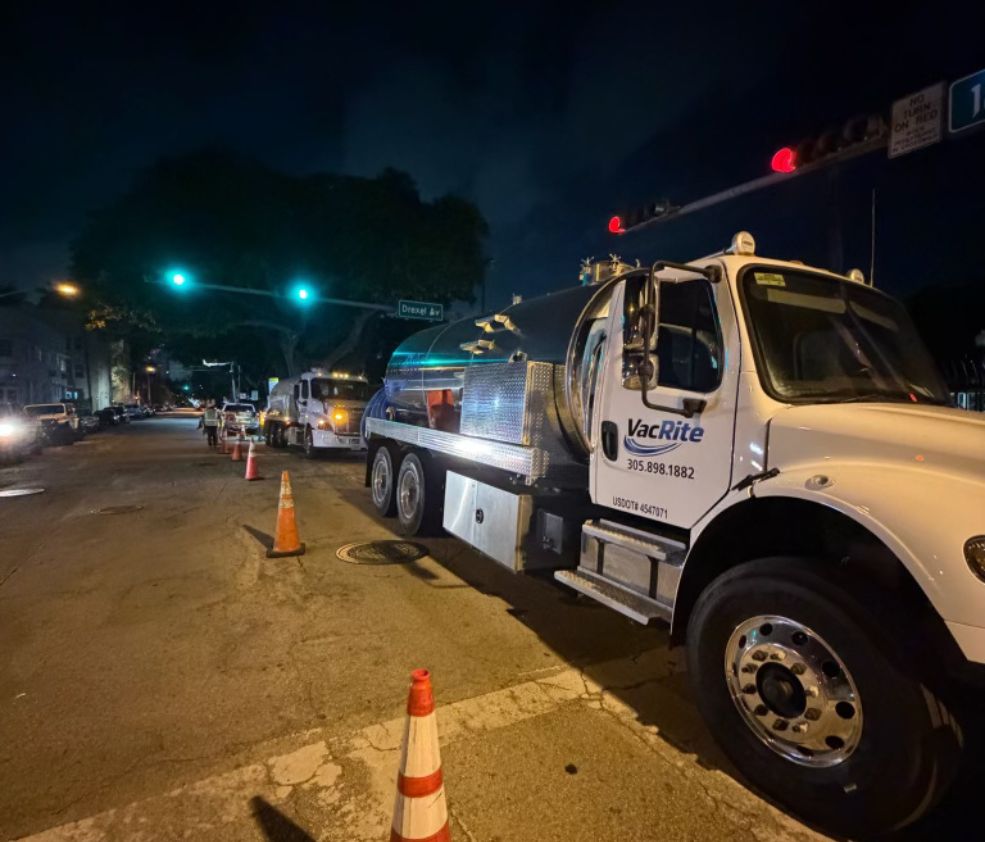
Emergency excavation happens where the failure is, which is rarely anywhere convenient. A parking lot at closing, a median on a six lane road, a plant floor, the back of a strip center between a dumpster and a wall. At night the ordinary problems get harder. Lighting has to come from us or from somebody. The staging that would be obvious in daylight has to be worked out with a flashlight. A truck that fits the space by inches is a truck that does not fit. If the work is in the roadway there is a traffic control question that does not go away because it is late, and in most municipalities a permit question behind it. In rainy season, add the possibility that the storm which caused your problem is still overhead. None of this is unusual for us and all of it goes faster when somebody on your end can meet the truck.
Alongside the repair crew and the utility owner
Our part is frequently not the repair. It is getting the line uncovered, clean and workable so the crew who fixes it can start, and then staying while they do. That means the hole gets sized for the person going into it and the tool they are bringing, with room around and under the pipe for a clamp, a coupling or a fusion machine, not just enough room to see the leak. It means keeping the water down while they work instead of handing them a hole that fills back in. On a struck facility the owner has their own people, their own procedures and their own paperwork, and we work inside that rather than around it. When there is a restoration contractor on site the sequence gets coordinated so nobody is standing still. Multiple companies converging on one hole in the dark can go badly. Mostly it goes fine, and it goes fine when everybody knows who owns which part before the digging starts.
Why the phone gets answered
This company is first responder owned and operated, and the emergency side of the business reflects that. Calls at two in the morning are not an inconvenience that the phone system is designed to absorb. Somebody answers. That is a habit of mind carried over from work where the call always came at a bad hour and going was never optional. It also helps that the trucks are ours. There is no broker in the middle trying to find somebody willing to roll at that hour, no hoping a subcontractor picks up, no call back in twenty minutes to say nobody was available. The person who answers can commit a unit while you are still on the line. What we ask in return is that you spend thirty seconds on access before you hang up, because the difference between a useful truck and a truck parked at a locked gate is a gate code somebody knew at two in the morning.
Worth knowing
On an emergency call, tell us about access before we roll. A truck that cannot reach the hole is not much help, and knowing about a gate, a height restriction or a soft shoulder in advance saves an hour nobody has.
Ask any contractor where what they pump out actually goes. It is a fair question, and the answer tells you a lot.
VacRite
Other excavation work
The other side of the company
Most of our customers only ever need one half of what we do. It is worth knowing the other half exists.
Something failed tonight. Somebody answers.
Struck line, blocked kitchen drain, a basin backing up in the middle of a storm. We run every day of the year, and the phone reaches a person rather than a queue. This company is first responder owned, and the emergency side of it works the way that suggests.
Questions we get asked
Do you really answer at night and on weekends?
Yes. We run around the clock, every day of the year.
How fast can you get a truck out?
It depends on where the job is and what is already running. Call and you will get a straight answer about timing rather than a maybe.
Can you work alongside our repair crew?
Regularly. Frequently our part is exposing the line so their part can start.
What if the line is already leaking?
Tell us that on the call. It changes the approach, the safety plan and who else needs to be on site before anyone digs.
Do you cover emergencies outside Miami?
Yes. Our excavation side travels well beyond the local area, and how far we can get how fast depends on where you are.
What do you need to know on the first call?
What failed, where it is, what is around it, and whether anything is still flowing or energized. Then access, which is the one people forget: gate, key, overhead clearance, whether the truck can sit where the hole is, and whether the work is in a travel lane. Nobody expects a tidy scope at that hour. Tell us what you are looking at and we will ask the rest.
Can the hole be kept open and workable until our repair is done?
Yes, and that is usually the arrangement. The hole gets sized for the person going in it and the tool they are bringing, dewatered while they work, sloped or shored for what the soil is doing, and protected between shifts. Backfill and restoration happen when the repair is signed off rather than being reopened later.
We run emergency hydro excavation across South Florida, including Miami, Fort Lauderdale, West Palm Beach, and the rest of the region. See every city we cover or look at the trucks on the job.
Tell us what the job is
Tell us about the emergency hydro excavation job. Where it is, what is around it, and when you need it.
Two trades, one call. We own the trucks, hold the permits, and put our own people on the job.
VacRite, Miami
info@vacriteservices.com
Open 24/7/365
USDOT 4547071