
Grease Trap Service Scheduling
Working out when your trap actually needs service, and putting the visit in a window your kitchen can absorb, instead of running on a default number somebody wrote on a form.

Operations managers, chefs and owners tired of guessing, facilities departments coordinating several buildings, and anyone whose current schedule was inherited from a previous vendor and has never been questioned.
How a job runs, step by step
Establish a baseline
Read the structure on arrival and record grease depth, solids depth and liquid level. One reading is a data point. Two or three make a loading rate.
Convert loading into days
Capacity, threshold and rate of accumulation give a number of days to threshold. The visit gets set comfortably inside that, not on it.
Pick the window your operation can lose
Overnight, pre-opening, between services, dark day, summer break. There is almost always an hour that costs the kitchen nothing.
Lock the recurrence and send reminders
The visit repeats on the same rhythm and you hear from us before it, so nobody at your location is tracking a calendar.
Re-read the numbers and adjust
Loading changes when kitchens change. The interval follows the readings rather than staying where it was set in year one.
Where the default interval comes from and why it is only a ceiling
Nearly every ordinance in this part of the state lands on the same language: service at a quarter of capacity or every ninety days, whichever comes first. It is a sound rule and it is widely misread as a schedule. It is a maximum. The clause that does the real work is the first half, at a quarter of capacity, and that half is specific to your kitchen and your equipment. A quarterly visit on a trap that hits the threshold in fifty days leaves you out of compliance for forty days a quarter, every quarter, with a vendor invoice that says otherwise. A quarterly visit on a trap that would take two hundred days is a truck rolling for no reason. Both look identical on paper, which is exactly the problem. What makes the difference is a number nobody usually collects: how fast this particular structure fills. That is not hard to get. It requires somebody to measure on arrival, write it down, and do it again next time. Without those readings the conversation about interval is two people trading opinions, and the trap is the only one who knows.
Reading a trap: the numbers that set a date
There are three readings and each answers something different. Grease cap depth tells you how much fats and oils the kitchen has floated since the last visit, which tracks fryers, grills, woks and the volume of cooking. Solids depth tells you about scraping habits, strainer use and prep volume, and it is the reading that most often catches people out because solids are invisible from the lid and they steal capacity just as effectively as grease does. Total liquid level tells you whether the structure is holding what it should, and a level that does not match what the kitchen sent points at groundwater infiltration through a failed joint, which is common here and which quietly eats retention volume. Put grease and solids together against the structure’s rated capacity and you have a percentage. Put that percentage against the days since the last visit and you have a rate. Rate into the remaining margin gives days to threshold, and the visit goes comfortably inside that with room for a busy month. That is the whole arithmetic. It is not complicated, it just has to actually be done, by somebody who is willing to write the numbers down whether or not they flatter the schedule they sold you.
Seasonality, menus and the things that move a South Florida interval
A kitchen is not a constant, and around here the swing is bigger than most places. A lot of operations run heavy from late fall through the spring and go quiet in August, so a single interval set in February will be too loose in season and too tight out of it. Hotels and resorts move with occupancy and event calendars. School and university kitchens go nearly dark for a summer and come back at full volume in a week. Stadium and venue kitchens produce a season’s loading in a handful of dates. Menu changes move loading without anybody thinking of them as plumbing decisions: adding a fryer program, switching to a heavier protein mix, taking on catering, extending brunch to seven days. So does staffing, because a new crew that rinses pans rather than scraping them will show up in the solids depth within two visits. On a shared interceptor, a tenant change can reset the whole calculation on its own. Scheduling that acknowledges all this means a seasonal interval where it makes sense, tighter through the busy months and relaxed through the quiet ones, reviewed against the readings rather than assumed.
The window matters as much as the interval
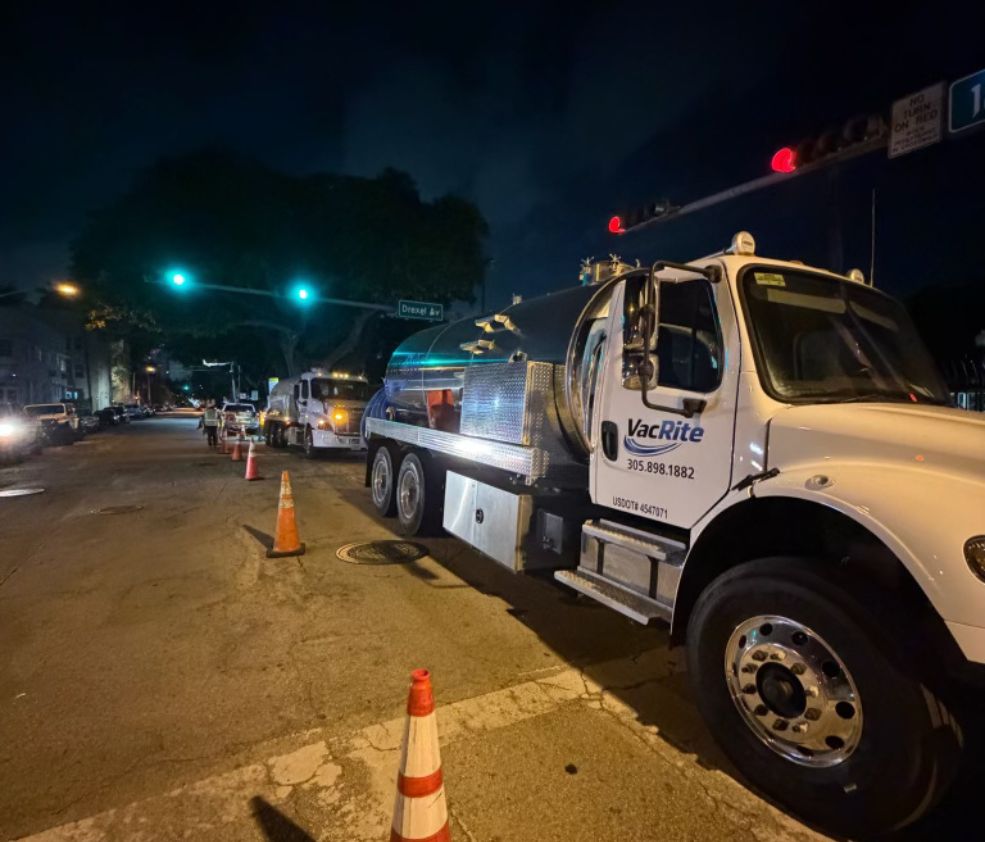
An interval that is correct and a window that is inconvenient produces the same outcome as no schedule at all, because the visit gets pushed. A kitchen will not surrender a dinner service to a truck, and it should not have to. Almost every operation has an hour that costs it nothing, and the job is to find that hour and then defend it. Restaurants are usually overnight or straight after close. Supermarkets are pre-opening. Hotels work between banquet events. Schools have dark days and summers. Municipal kitchens often prefer early morning before staff arrive. Because we run 24/7/365 with our own trucks and our own CDL drivers, we can move our night instead of moving your service, and that is the practical difference between a schedule that holds for a year and one that has slipped three weeks by March. Access shapes the window too: an interceptor under a delivery lane is a different appointment at six in the morning than at two in the afternoon. Once a window is set for a location it tends to stay set, your staff learn it, and the whole thing stops being something anybody has to manage. Call 305-761-4311 and we will read your trap, work out what it actually needs, and get a truck out on a window that fits.
Worth knowing
An interval that keeps getting shorter is not a busy kitchen, it is a symptom. Either the previous services left solids behind, in which case the trap starts each cycle already loaded, or a piece of hardware has failed and the structure is no longer separating. Find out which before you simply book more visits.
Ask any contractor where what they pump out actually goes. It is a fair question, and the answer tells you a lot.
VacRite
Other compliance work
The other side of the company
Most of our customers only ever need one half of what we do. It is worth knowing the other half exists.
Something failed tonight. Somebody answers.
Struck line, blocked kitchen drain, a basin backing up in the middle of a storm. We run every day of the year, and the phone reaches a person rather than a queue. This company is first responder owned, and the emergency side of it works the way that suggests.
Questions we get asked
How do we know how often our trap really needs service?
By measuring it. Grease depth, solids depth and liquid level recorded on each arrival give a loading rate after two or three visits, and the interval comes off that rate. Anything before that is a starting guess.
Is quarterly enough?
It is a maximum, not a target. Plenty of kitchens hit a quarter of capacity well inside ninety days, and some never come near it. Quarterly is the right answer only when the numbers say so for your trap.
Can we go longer between services to reduce visits?
Only if the readings support it. Past about a quarter full a trap stops separating and starts pushing grease into your lateral, and a blocked line costs far more than the visit you skipped. If the numbers show slack, we will tell you and stretch the interval.
Do you send a reminder before the visit?
Yes. You hear from us ahead of the scheduled service, so nobody at your location is responsible for tracking a calendar.
Can you service us overnight or before we open?
Yes. We run 24/7/365 with our own trucks and CDL drivers, so the window is picked around your operation. Overnight, pre-opening and between events are all normal for us.
Our business is seasonal. Can the schedule change with it?
It should. A lot of South Florida operations run heavy in season and quiet through the summer, and a single fixed interval will be wrong in both directions. We set a tighter interval for the busy months and relax it for the slow ones, checked against the readings.
We just changed our menu. Does that affect the schedule?
Often more than people expect. Adding a fryer program, heavier proteins, catering or an extra service period all change loading, and it turns up in the depth readings within a couple of visits. Tell us when something changes and we will watch for it rather than wait for the line to tell us.
We run grease trap service scheduling across South Florida, including Miami, Fort Lauderdale, West Palm Beach, and the rest of the region. See every city we cover or look at the trucks on the job.
Tell us what the job is
Tell us about the grease trap service scheduling job. Where it is, what is around it, and when you need it.
Two trades, one call. We own the trucks, hold the permits, and put our own people on the job.
VacRite, Miami
info@vacriteservices.com
Open 24/7/365
USDOT 4547071